Han Chin Pet Soo – The Hakka Miners' Club
Han Chin Pet Soo or Han Chin Villa is a new museum/exhibition in Ipoh. It is located in the old Hakka Miners’ Club building. Mining Towkay Leong Fee set up the Han Chin Tin Miners' Club in 1893. Leong Fee arrived in Malaya in 1876 and succeeded in tin mining and set up the club for tin miners.
Han Chin Villa is located at No 3. Jalan Bijeh Timah (Treacher Street). The Kinta River is just behind. At that time the club building was just a double storey shophouse. Entry was restricted to Hakka miners, and men only. It was a social place for them to meet friends, smoke opium and gamble legally and entertain "dancing girls" hence the men only rule.
Leong Fee died in 1912 leaving 4 wives, several concubines (mistresses) and numerous “dancing girls”. The club was later bought from Leong's son and in 1929 was rebuilt into the structure seen today. It is quite unique with a bay window, eyebrow windows and a ribbed dome and even what look like Muslim tombstone structures.
The club is still used by members although nowadays there are very few surviving miners, most of the members being sons of miners who are still connected with the tin industry. However the 3 storey building has now been lovingly restored under a project was set up by Ian Anderson of
Ipoh World.
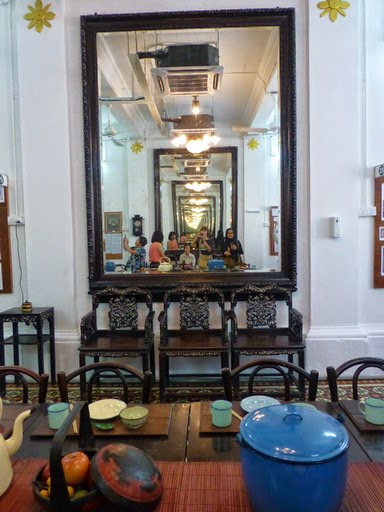
The front door opens straight into the dining room. The large table is laid with pieces from the time period and there are two huge infinity mirrors. Looking down on the room is a picture of Leong Fee who founded the club.
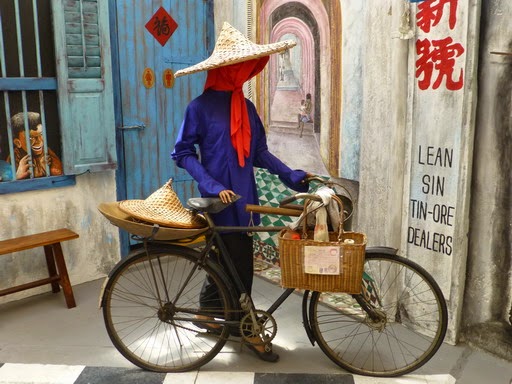
The next item is a display case of small mining items, including rock samples, tin money and a hat worn by the female workers. From here you step into a corridor with a long mural of a scene from a tin mine. It was painted by students from PIA. There are also several mannequins going about the various jobs and each one is dressed in typical clothing from that time.
In a small side room you get the chance to watch an old educational video about tin from Malaya. It is quite detailed and very interesting. Next to this room is another small room that was the maid's room and contains a wardrobe with cheongsams etc.
From here you step into the kitchen which is exactly how it was. There are charcoal stove plus one for wood. I loved the collection of old tins.
Outside is the 'town square' with murals on all the walls showing street life. Two naughty Malay boys laughing at a Chinese coolie, a tin ore dealer, a dredge and a Malay house with elephants.
From here you go upstairs to the first floor to the 4 evils - opium, gambling, prostitution and the triads. Opium was legal in those days, taxed by the British.
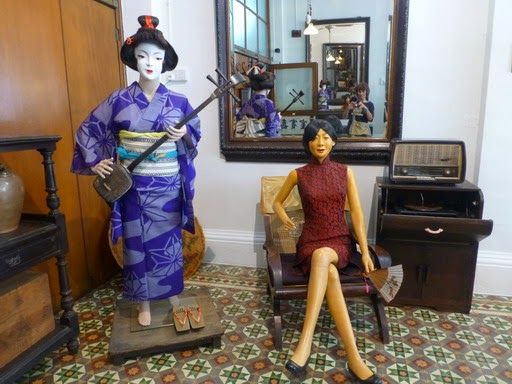
Inside the gambling room you see a table of gamblers and various examples of other games played. The entertainment was provided in the form of 'wine, women and song' - there is a bar, Japanese girl and a girl in a cheongsam and an old radio - 78 record player. The windows have been restored to how they were originally.
Upstairs again to the second floor. The stairs are all the original wood. The upper floor was for the guests. There is a small bedroom set up as it would have been in the 1930s with no running water or toilet. I can imagine the room would have been horribly hot. The bed is large enough to sleep about 3, and there are some original fold up camp beds. Next door is a more modern bedroom from the 1960s and outside is a toilet. 1930s room -
Around the walls are displays about the Hakkas. Hakka means 'guest families'. These people originally migrated from north China to the south, where they settled in Fujian and Jiangxi provinces where they lived in secure contained villages. They then migrated to Malaya via Singapore. There is a fascinating extract from a diary written by one man in 1926 describing his journey from China to Papan in Perak.
Back downstairs and you pass through an office with old equipment, safe etc. Next is a photo board of Hakka food and final items about the club.
The visit is a fascinating step back in time. Guided tours are available 6 days a week and bookings can be made through
IpohWorld reservation.
Admission is free but donations are welcome. New additions are regularly added to the displays so it can be worth a repeat visit. The club is available for private functions such as themed dinners.