Enjoy!!!

Enjoy!!!

Sunday, October 21, 2012

Yangon, Myanmar (BT)

Published on The Brunei Times (http://www.bt.com.bn/en)
Lost in time in Yangon


A charm of its own: Colonial buildings in Yangon makes for a picturesque scene. Picture: Liz Price
Liz Price

Sunday, March 15, 2009

YANGON is a city of generators.

The pavements are full of them, from small portable ones to large ones the size of a car. And they are noisy, but necessary. The electricity supply is insufficient to cope with the demand and blackouts are frequent.

Downtown is a contrast of decaying buildings with new ones popping up in between. There are some grand old colonial buildings such as the huge but no longer used Ministers' Office, and the High Court and financial area buildings.

Although Yangon is still the commercial capital of Myan-mar, the administrative centre was moved to Naypyidaw in November 2005.

Despite being a Buddhist country, in downtown Yangon there seems to be more mosques and churches than Buddhist temples. Standing on one corner I could see three mosques within a few hundred metres of each other. There is also a scattering of Hindu and Chinese temples. Just up the road from my hotel was the Muslim free hospital, for the poor of all communities.

The roads are built on a grid system, with lots of narrow lanes connecting the main roads. These lanes are lined with buildings around four storeys high. The architecture is so varied, some buildings have balconies and verandas, windows of different sizes, ornate features.

There are not many sites to see. The most famous one is the Shwedagon Pagoda. This splendid stupa sits high on the sacred shrine of Singuttara Hill, and houses relics of The Buddha and three Buddhas that preceded him. Shwedagon is an impressive place, and the brightness of the abundant gold paint is almost dazzling in bright sunlight. It's not clear how old the pagoda is as archaeologists and Buddhists give different ages, but the current stupa was built in the 15th century and is 98m high. It is one place that every visitor to Yangon has to see.

Another thing to do in Yangon is have high tea at The Strand. In colonial days, The Strand was the hotel, built by the Armenian Sarkie brothers. They also built the E&O in Penang, and Raffles in Singapore. I was lucky enough to stay there in 1986 prior to renovation. But even now you can still see the grandeur of the place, with its wooden and rattan furniture, high ceiling fans and old style shutters on the windows.

Myanmar and Yangon have not really changed much over the decades and still retain an image of the past. Twenty years ago, it was common to see old cars such as Austin on the streets but these have virtually all disappeared, which is quite sad. However you can see some older cars, mostly Japanese.

Yangon is still worthy of a visit, especially if you like to go back in time and see how things were before the modernisation changed things.

The Brunei Times

---------------------------------------------------------------------------

Source URL:
http://www.bt.com.bn/en/en/travel/2009/03/15/lost_in_time_in_yangon

Perak's museums


Malaysia's first museum: (Top) Established at Taiping, Perak in 1883. (Above) Muzium Darul Ridzuan in Ipoh Pictures: Liz Price

Published on The Brunei Times (http://www.bt.com.bn/en)
Perak museums different from others
Liz Price
MALAYSIA

Sunday, May 3, 2009

WHEN the word museum is mentioned and a lot of people would shudder or turn a deaf ear, as museums are often considered boring places. But I find Malaysian museums are quite interesting, especially if they are located in old colonial buildings. As these buildings are small, you can look around the whole area without getting bored.

Malaysia's first museum was established in Taiping in Perak in 1883, with Leonard Wray as the first curator. Wray was a collector of flora and fauna, and was also a keen photographer.

These hobbies helped him establish a name for himself and the museum.

In the 1890s, he collected a series of ethnographical photographs of aborigines of the Malay Peninsula and also produced an album of public works in progress in Perak during 1892-93. His photos formed a good collection in the Perak Museum.

When you mention the Perak Museum, some people assume you are referring to the museum in Ipoh, which is the state capital of Perak.

However Perak Museum is the name of the one in Taiping. The building was completed in 1886 although additions were added later.

It is an impressive white building with turrets. An arched porch leads to the entrance and you almost feel as if you are entering a castle or stately mansion. Inside are four galleries but the first thing you see is the imposing throne of the late Sultan of Perak.

In the early days the museum pioneers concentrated mostly on the flora and fauna as started by Wray. It was only in later years that the museum began to add collections relating to the culture of Malaya.

Today the museum has a rich collection of cultural, natural, prehistorical and archaeological exhibits. The cultural exhibits include the economy and ethnology. The archaeological treasures are quite impressive and include ancient weapons, aboriginal hunting and farming implements. In addition the anthropological collection include dresses and ornaments, as well as household items. There are also musical instruments and symbols of religious items, as well as ones used for births, deaths and marriages.

I like seeing the stuffed animals as it's difficult to see these animals alive, especially in the wild, so to see them in a museum gives you a good idea of their physical size and shape. Flora is less well represented as the herbarium section has moved to the National Museum in Kuala Lumpur.

The Muzium Darul Ridzuan is located in Ipoh, north of the padang and St Michael's Institution. It is housed in a villa built in 1926 for a wealthy Chinese tin miner.

In those days it was a government building, and then during the Emergency in the 1950s that followed from World War II, the building was used as the headquarters of the Home Guard. In 1991, it was converted into a museum and opened for public following year.

Some people find it less interesting than the Taiping museum, and say the displays are not inspiring. This is because the museum only really has two main sections, tin mining and forestry. The purpose of the museum is to preserve the mining history and forestry from the Ipoh area, and to retain relics from these historical heritages.

I have an interest in tin mining and the downstairs displays show the history of this once thriving industry. Ipoh is often referred to as "the town built on tin" and "the city of millionaires," both names relating to the tin industry and those who made it rich.

The displays do show other things than tin. You can read up on the history of the city of Ipoh, see the keris or sword collection, and learn about the Perak royal family and see objects from their personal collections, including some old royal vehicles.

Upstairs features the section on forestry. Outside there are two concrete air-raid shelters in the garden, erected in 1941.

There are more exhibits on tin mining alongside the building, where you can see items used by the miners to extract and process the alluvial gold. The museum holds occasional temporary exhibitions which could be quite interesting.

The objectives of these two museums are to protect and display the world of Perak's culture, its history, flora and fauna. They also provide research opportunities as well as help promote tourism.

The Brunei Times

--------------------------------------------------------------------------

Source URL:
http://www.bt.com.bn/en/en/travel/2009/05/03/perak_museums_different_from_others

Thursday, October 11, 2012

NGOs protest against book ban

THE STAR
Wednesday December 10, 2008

NGOs protest against book ban with 1,000 signed postcards


PUTRAJAYA: A group of 10 non-governmental organisations including Sisters in Islam, Suaram and representatives from the Bar Council handed some 1,000 postcards protesting against the banning of books to the Home Ministry here.

SIS senior programme manager Maria Chin Abdullah said the postcards were collected from September and bore the signatures of people voicing their protest over the ban.

“We are concerned because the guidelines leading to the ban of books are vague and the decision by the Government is often arbitrary. Some of the banned books have also been published and widely sold in stores for some time but then, the Government decides to confiscate them.

“Similarly, we didn’t even know the books were banned until we read about it in the newspapers,” she told reporters here yesterday, pointing to a book published by SIS — Muslim Women and the Challenge of Islamic Extremism — as an example.

“We want the ministry to call for a consultation with all the parties involved in the publication of books to resolve this matter. Banning books has a negative effect on information and intellectual development,” she pointed out.

Maria said the non-governmental bodies also wanted to know if writers would be compensated for losses suffered when their books are damaged or destroyed in the confiscation process.

The SIS book was edited by Prof Norani Othman from Universiti Kebangsaan Malaysia, who was also present.

--------------------

Autobacs 4WD rally 2005 Thailand


THE STAR
Lifeliving
Saturday October 1, 2005


Stirring up some excitement

Story & Pictures by Liz Price

There is something thrilling about waiting for a rally car to pass. Your ears strain to catch the distinctive throaty roar. Sometimes you make a mistake and are disappointed when a motorbike swings into view. Other times you see the rally car coming before you hear it – or rather you see an approaching swirl of dust, inside of which is a car.

This year’s Autobacs Asia Cross Country Rally, the 10th of the Asia XC series, took place in Thailand Aug 6-12.


Sanctioned by the FIA (Federation Internationale de Automobile) for the first time, the seven-day event, organised by Ortev of Japan, covered some 3,400km, 1,000km of which took place on 10 SS (selective section) where the cars were subjected to the rigours of the terrain.

A fleet of 44 cars representing Malaysia, Thailand, Japan, Korea and Taiwan left the starting line in Bangkok. Including vehicles for the media, service crew, sweepers and officials, the entire contingent numbered more than 100 cars.

Each morning we got up at 5am, ate a large breakfast because we knew we wouldn’t have time for lunch, and hit the road an hour later. Our first destination was the historic city of Ayutthaya, then Mae Sot on the Myanmar border, climbing mountains and braving the rain. After Mae Sot, we drove past the largest refugee camp in Thailand.


The Malaysian and Korean teams.
At Mae Sariang, we took photos of a temple with Shan-styled chedis. The area here is populated by hill tribes, and we saw many of them in their bright clothes as we drove by at high speed. We were always in a hurry, trying to keep ahead of the rally cars.

Mae Hong Son is a touristy place with lots of farang (foreigners). Here everyone was allowed an hour’s worth of sightseeing; and we all went to see a “long-necked village” outside Mae Hon Song. The women were quite obliging and had their photos taken beside the colourful cars.

From Pai, we drove five hours to Chiang Rai. As usual, we only arrived at the hotel late in the evening. Our next stop was Sukhothai, another historic city, and again, I was only able to catch a glimpse of a couple of chedis as we drove out at six am the following morning.


Going for a ‘swim’.
We had left the mountains behind by now and were entering farmlands. We drove through large plantations, where tapioca and pineapples were grown, and saw large farms where cows were reared. The last day took us through Thailand’s oldest National Park, Khao Yai. The main road ran through the park, and all vehicles had to observe the speed limit. The rally ended in the coastal city of Pattaya.

The 10 selective sections covered different types of terrain, and the weather played a role in how tough these turned out to be. In each SS, the driver had to concentrate for hours, guiding his car over the rough and tricky areas, with the co-driver navigating.

Japan had 13 cars in the race. One was driven by Ukyo Katayama, an ex F1 driver, who managed to finish 8th. There was just one ladies team, driven by Ray Itoh from Japan and a Taiwanese co-driver.

Representing Malaysia for the 5th year were the Ho brothers, with Francis as driver and Jacky as co-driver. This year they competed in a Land Rover Discovery and made sure and steady progress. Unfortunately they ended up wasting valuable time winching out other cars which got stuck in the mud.

The worst of the SS was when the cars had to negotiate a very slippery and hilly 90km. We waited for them to finish at a village, and it was a long wait. When we finally heard a rally car in the distance, we ran back to snap photos.


It was 35 minutes later before the next car arrived. An hour later, a third car approached, and then no more. The remaining cars had got stuck in mud at Km66. Once they were all extricated they turned back to the starting point, and the afternoon SS had to be postponed.

Another exciting SS involved a river crossing. The first few cars got through without any problems. However, they dug out the soft riverbed and made the water deeper for the next cars. Soon the first car got stuck and the co-driver had to climb out to look for a tree to attach the winch.

Alas, there were no trees, and they had to wait for someone who was willing to stop and help. Soon another car got stuck, then another. At one point there were three cars stuck at once. All had to be winched, with one getting a push from the locals.

Another SS was delayed when the cars encountered logging trucks on the track and there was no room to overtake. One SS required the drivers to negotiate padi fields, twisting and turning along the narrow raised tracks. We stood in tapioca fields, amongst pineapples and tall corn, watching. In many places, the friendly locals gave us corncobs to chew on whilst we waited.


Young spectators.
The rally ended in Pattaya. The overall winners were from Korea, who drove a Ssanyong Musso. Second and third placing went to Thai teams, who drove a Toyota Hilux and Isuzu D-Max respectively. The winning team received 120,000 Baht (RM12,000) in prize money. Only 32 out of the initial 44 cars finished the rally. The two cars from Taiwan had their service crew run out on them on Day 3.

All in all, though, things ran smoothly, and there were no major accidents or injuries. W


Source:

Wednesday, October 10, 2012

Trainspotting in the Klang Valley

Star Lifestyle

Saturday July 9, 2011

Trainspotting in the Klang Valley

Story and photos by LIZ PRICE

Trainspotting is an old-fashioned hobby, but one that can easily be enjoyed in Kuala Lumpur and the surrounding Klang Valley.
‘Trains are wonderful... to travel by train is to see nature and human beings, towns... and rivers, in fact, to see life’
– Agatha Christie

KUALA Lumpur can be considered a trainspotter’s paradise.
The Klang Valley has several different lines carrying various types of train, and these all pass through KL. There are trains running at ground level, there are trains high above our heads and some that go underground. Some of the carriages are brightly painted with adverts designed to catch the eye.

Power on track: The electric train service.

What’s trainspotting?
It’s an old-fashioned hobby that involves collecting sightings of trains. In the Klang Valley, it would be easy to enjoy this hobby. One would only have to sit at a station such as KL Sentral or the old KL station, and many of the trains would pass in front of your eyes.
Trainspotters typically “collect” engines, recording the data of all that they see. It could be engine numbers, names or types. They may also record other railway equipment that takes their fancy, or perhaps the movements of trains.
The trainspotter might concentrate on a certain type of trains, such as passenger trains on different lines or belonging to different companies. Or perhaps he may prefer to look for moving stock, such as that belonging to one company, or different types of stock.
Today, modern trainspotters have it easy, as they can check train times and railway information on the Internet. Enthusiasts can maintain electronic records, and railway information can be kept up to date on the computer. This has led to virtual trainspotting, in which online pictures of trains are collected.
Years ago in the days of steam, some enthusiasts carried tape recorders not only to speak of their findings, but to record the sound of the locos. A camera is a vital piece of equipment, especially since there is so much advertising on the coaches these days.

Speedy delivery: The KLIA Express.
The Klang Valley certainly has some colourful trains. The monorails are the most visual, as they pass high above our heads above the streets of KL. They look bright and cheerful with their multicoloured livery adorning the sides. The monorail has become an icon of KL, as it is so visible. Opened on Aug 31, 2003, and serving 11 stations running 8.6km, it connects the Kuala Lumpur Sentral transport hub with the “Golden Triangle” area of Bukit Bintang and goes on to Titiwangsa just beyond Chow Kit.
The trains are short, consisting of just two carriages. These run on two parallel elevated tracks which are on a single support. The maximum capacity of the monorail is 244 at full load with 48 people sitting and 196 standing. However, this is never enough during rush hour.
It’s quite satisfying to ride the monorail during peak traffic times and look down on the congested gridlocked streets below, and be thankful you’re being whisked in clean, air-conditioned comfort to your destination.
The Light Railway Transit, or LRT, meanwhile, is a dual-track railway that runs on and underground in contrast to the overhead monorail. And unlike the latter, the LRT has several lines that run around the Klang Valley and criss-cross the city.
The LRT is operated by two different companies, Putra and Star, and these two lines only intersect at one station – Masjid Jamek. Here, if you want to switch lines, you have to exit and walk across or under the road to get to the other station. And because the two lines are operated by two different companies, passengers have to pay separately to use each line.
The Star line runs on and at times above ground, whereas the Putra line has a combination of ground level and underground tracks. The trains are fully automated and driver-less, have more carriages and are longer than the monorail.
Let’s do the locomotive: Old steam engine.
The LRT was made famous by the 1999 film Entrapment starring Sean Connery and Catherine Zeta Jones. Although they filmed at Bukit Jalil station, the filmmakers used the Pudu sign.
Another above ground rail system is the KTM Komuter train. This runs from Rawang in the north to Port Klang in the southwest and Seremban to the south. The train is a fast and cheap way to move commuters around the Klang Valley.
In April 2010 the Komuter introduced its Ladies Only carriages, a first in Malaysia. With distinctive pink signs and stickers, the Ladies Coach is located in the middle of each Komuter train. However I have seen men use it. I don’t know if they are oblivious to the pink signs or simply don’t care.
One connecting station for all these lines is KL Sentral. This serves as a hub for LRT and monorail services as well as the KTM Komuter. It is also the terminus for the express rail link (ERL) to the Kuala Lumpur International Airport. The KLIA Express is a non-stop, high-speed train service that connects KLIA with the city, running at a top speed of 160kph.
KL Sentral has replaced the old KL station. The old KL station is well known for its Moorish architecture with the domes and minarets. The station itself is of a simple layout, with the rail lines running through the rectangular-shaped building. In contrast KL Sentral is more complex, with trains running at different levels, from below ground to high above ground.
KL Sentral is a great place for trainspotters. Any enthusiast could spend quite some time at the station, watching the various trains arriving, departing and just passing through. The station is also on the main intercity rail line, connecting with Singapore and Thailand. Express and slow mail trains pass through this station.
The relatively new Electric Train Service (ETS) connects KL to Ipoh. This started in August 2010. Being the newest kid on the block, the trains are smart and the carriages equipped with modern conveniences. Initially, there were two services – transit and express. Now these have become Platinum, Gold and Silver, depending on the speed and number of stops. The train has a top speed of around 148kph.
Goods trains also pass through KL Sentral and KL stations. These include long wagons full of cement, chemicals, petrochemicals and industrial products.
Another good place for an enthusiastic trainspotter would be the new bus terminal, Terminal Bersepadu Selatan at Bandar Tasik Selatan (TBS-BTS) in Selangor. This has replaced the newly renovated Pudu Raya bus station for all southbound buses. The terminal is located next to the Express Rail Link (ERL) KLIA Transit Station, the Stesen Komuter KTM Bandar Tasik Selatan and the Bandar Tasik Selatan LRT Station (Star LRT).
To end on a splendid note, I’d like to point out that the Eastern & Oriental Express, a luxury train, winds its way between Singapore, Malaysia and Thailand, and on into Laos. This is the sister train to Europe’s Venice Simplon-Orient-Express which was made famous by Agatha Christie’s 1934 book Murder On The Orient Express.
The golden age of travel lives on with the Eastern & Oriental Express luxury train, and it would be a grand addition to any trainspotter’s collection.

Fact file
Surprisingly some of these rail transport systems do not have a website. The ones that do give maps showing rail network, timetable and fares and other general information.
Electric train service, KL to Ipoh
http://www.ets-train.com.my/web/ets/
Keretapi Tanah Malaysia
http://www.ktm.com.my/
KTM Intercity
http://www.ktmintercity.com.my/
KTM Komuter
http://www.ktmkomuter.com.my/
KLIA Express
http://www.kliaekspres.com/


Source:


Copyright © 1995-2011 Star Publications (M) Bhd (Co No 10894-D)

Thursday, July 26, 2012

Tabebuia are in flower July 2012

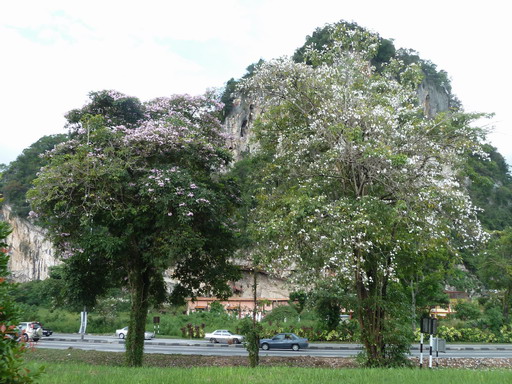
Last week (17 July 2012) I noticed the big tree in my condo car park was flowering. I have never seen this before. And I saw many of the same trees flowering in Ipoh along the main road around Simpang Pulai.
Pink against blue

The trees are Tabebuia, or trumpet trees. They are native to America. They only flower in the dry season. And Malaysia is going through a dry period even though the SW monsoon has started.


Tabebuia is widely used as ornamental tree in the tropics due to its impressive and colourful flowering. Because a lot of the leaves have dropped off in the dry season, the flowers are even more conspicuous.
The flowers come in various colours ranging from bright pink, light lavender to white. They are tubular in shape, like a trumpet. Different species are known as Pink Trumpet Tree and White Trumpet Tree.
White and lavender (above) and white (below)


The flowers only lasted about a week. As they were falling in the wind it looked like it was snowing! A carpet of flowers


© Liz Price
No reproduction without permission

Monday, July 23, 2012

Old parts of Brickfields

I read in the New Straits Times on 22 July 2012 that more parts of old Brickfields would be pulled down for development. Already a lot of the old Brickfields has been lost, and there are lots of new highrises, especially around KL Sentral. The old police station closed down as well as the Pines restaurants.

It seems that the 100 government quarters along Jalan Rozario will be the next to be demolished. These are the rows of double storey link houses, between the Vivekananda Ashram and the old green by the traffic lights. The houses have relatively recently been renovated. The green or padang by the traffic lights disappeared when the Little India developments happened. Luckily one tree was spared.
100 govt quarters and the back alleys -
1997 view of the tree
Same tree in 2012 but the field has gone
Vivekananda Ashram
Fresh milk
Methodist school, and tree in school grounds
Jln Padang Belia where the old buffalo sheds were, the kandang kerbau
Old and new -
Blind society , printer
Paper supplier (above), old house -
This tree was in a car park in 2008, same car park 2012
This building is now occupying the car park
Old shop houses with washing hanging out
Siewdor, used by high ranking police 1967- early 1980s
Siva temple 70 yrs old

I will put the temples in a separate album.

© Liz Price
No reproduction without permission