Enjoy!!!

Enjoy!!!

Sunday, April 17, 2022

Bluebells in London & Wanstead Park

Every Spring I look forward to seeing bluebells. They are a classic British symbol of Spring. As a child I used to pick armfuls of them, but now they are a protected species.

Easter 2022 I spent 2 days looking for bluebells. Firstly I went to Harvington Woods near Kelsey Park, but there were hardly any, and most of those I saw were the invasive Spanish bluebells. So I gave up there. Having googled for bluebells in London, I read that Oxleas Woods at Shooters Hill were a good place. So in the afternoon I went there. Found a few patches, but it wasn't the large carpet of flowers that I was hoping for.


So it was back to Mr Google. That evening I saw an online news report about how Good Friday was the warmest day of the year, and that article showed a photo of bluebells in Wanstead Park. So I read up on that and decided to go on Easter Saturday.

I took the train to Redbridge. There I was confronted by the enormous roundabout with the very busy North Circular road crossing over it on high bridges. Fortunately there is a pedestrian subway underneath that lot.


View of the North Circular roads inside the huge roundabout


I then started walking down the River Roding trail, which is on the east side of the river. I soon realised I had to walk the whole length of the park before getting to a bridge over the river. I finally got into the park. I saw a sign to the grotto so headed for that. 


I later read that the grotto is a ruined boathouse from about 1762. It is a Grade II listed building. See details on Wanstead wildlife and also on Historic England. The boathouse pond -


From here I finally got into some woods and saw bluebells. I was happy. Although there was not the huge carpet as depicted in the previous day's news story. At least they were all the classic native British bluebell, not a Spanish one in sight.


I took loads of photos. Bluebells are a sign of ancient woodlands. Wanstead Woods is part of Epping Forest, which is a large woodland between Greater London and Essex.

Leaving the woods, I came out into the park. This is The Temple, built in 1760. It is a remnant of  Wanstead House, built in Tuscan style from ancient Rome.

I then noticed a patch of blue in nearby woods and went to investigate and realised this is the main area of bluebells. It was the huge carpet of blue that I had been looking for over the last 2 days. The large area had a path around it, to keep visitors away from the flowers.


The bluebell or Wild Hyacinth, Hyacinthoides non-scripta, has a bell shaped flower that droops, like the top of a shepherd's crook. The flowers are narrow and have rolled back tips. They have a slight sweet scent.
The invasive Spanish bluebells, Hyacinthoides hispanica, have upright stems and the conical bell shaped flowers  have open tips. There is no scent.

Bluebells are connected with a lot of folklore stories and fairies. It is believed that if you pick a bluebell you will be led astray by fairies and will wander lost forever. Fortunately this never happened to me as a child!

See more on bluebells on Woodland Trust .


Tuesday, April 12, 2022

Harland & Wolff to work on cruise ships again

 The historic Belfast shipyard is to work on cruise ships again after winning maintenance contracts from Cunard and P&O Cruises. Harland and Wolff is best known for building the Titanic. It also built many other liners as well as the Canberra which was a troop ship in the Falklands War.

The shipyard will work on Cunard’s Queen Victoria and P&O’s Aurora. 

The city of Belfast in Northern Ireland is dominated by the two cranes, Samson and Goliath. I saw them Sept 2019. At that time, the company was looking for a buyer. Workers were outside with placards to save H & W.


Harland & Wolff was formed in 1861. Having built many of the world's ocean liners the demand for those ships declined after the Second World War, especially with the increase in air travel. The shipyard was modernised in the mid 1960s, a large dry dock was made and Samson and Goliath arrived. 

After years of problems, see Wikipedia, fast forward to 2018 when the then parent company, Fred Olsen, put Harland & Wolff up for sale. As there was no buyer by August 2019, the company announced that they would cease trading and entered formal administration. I was there on 7th September when the workers were campaigning to save the shipyard. On 1 October it was announced the yard had been bought. 

So this historic shipyard was saved and is now doing maintenance work on cruise ships. The two ships. Queen Victoria and Aurora will be inside the dry docks in May and June respectively. This is the first time a liner has been inside the dry docks for more than 20 years. And the Queen Vic will be the largest cruise ship to dry dock in any UK shipyard. See was constructed in Italy. I last saw her in the Amazon in Jan 2020 -


View of the Belfast dockyard from the cruise terminal - 


Another P&O ship. Azura, was in dock in Belfast from June - Dec 2021. She was just being stored there during the covid pandemic, waiting to return to service. I saw her there July 2021 -


And another view of Samson and Goliath (through a coach window!).


So it is good to know this historic shipyard is back in business and now maintaining cruise ships.


Monday, April 4, 2022

César Manrique sculpture, Arrecife, Tenerife, Canary Islands

In 2014 I visited  the Cesar Manrique Foundation on Lanzarote on the Canary Islands. Cesar Manrique was a famous Spanish artist, sculptor and architect, born in 1919 on Lanzarote. There are many tributes to him around the island. He died in 1992.

When I was back in Arrecife in March 2022, I saw a new sculpture along the waterfront, "The Look of Cesar". It is located on the Avenida Marítima de Arrecife. It was installed as a tribute to the artist. The sculptor was Manolo González.

César's Look, or César's Gaze, shows him sitting in the center of an eye-shaped window, a metaphor for his illustrious gaze, his visionary spirit and his innovative character. Cesar had a great respect for nature and the work is a recognition and gratitude of the people of Lanzarote.

It was only installed on the 18th February 2022, so I was lucky to see it a month later. Read more here.

It was hard to get a good photo as the sun was so bright, and also people kept getting in the way, posing with Cesar.


Sunday, April 3, 2022

Teide volcano, Tenerife, Canary Islands

 The Mount Teide National Park on Tenerife is an area of geological formations - volcanoes, craters, vents, lava fields and interesting rock formations. The national park is dominated by Mount Teide. Its summit is the highest point in Spain, which surprised me. It is at 3715 m and is also the highest point above sea level in the islands of the Atlantic. It last erupted in 1909. 

The week before I visited, Storm Celia brought snow to Gran Canaria. There was certainly snow on Mount Teide and the roads through the park.

First view of Mount Teide -


The Canary Island Pine forests -


The Teide Observatory -


We continued along and our next stop was at Portillo Alto, where we had a different view of the volcano, 2nd photo shows a crater the other side of the road -


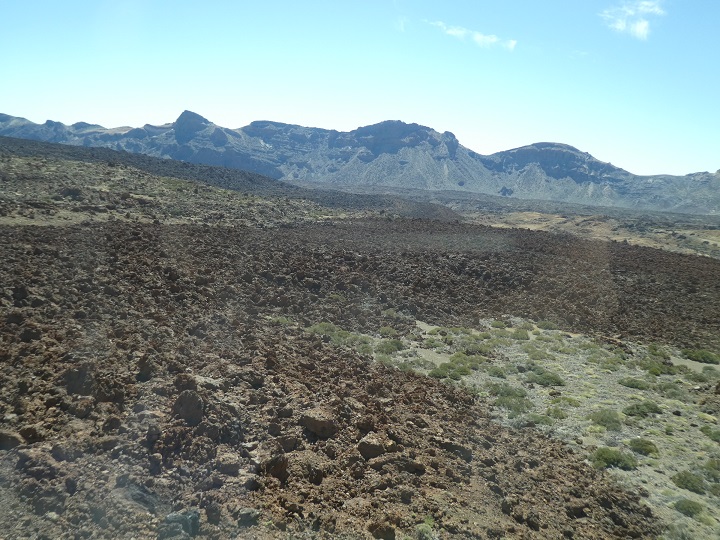
We continued on to the Canadas caldera. On the way we passed fields of pumice with lumps of glassy black obsidian, and lava channels -


When we reached the main viewing area, the road and parking areas were absolutely packed with vehicles and people.


The lava fields of Las Canadas caldera. The lava is the 'aa' type, meaning it is rough and knobbly and hard to walk on.


We were so lucky with the weather. In fact we were above the clouds, but had to go through them to go back down to Santa Cruz


Saturday, April 2, 2022

La Palma volcanoes, Canary Islands

The Canary Islands are part of Spain and lie off the coast of northwestern Africa. They are volcanic in origin. There are 8 main islands. La Palma is one of the smallest of the Canary islands and is very mountainous. It is the most north-westerly island of the Canaries and is heart shaped.


The capital Santa Cruz de La Palma is nestled at the foot of steep hills, has cobbles and is famous for the houses in Portuguese style with wooden balconies.

The island was in the news often from September to December 2021 due to the volcanic eruption. The eruption wasn't actually from a volcano, but from the Cumbre Vieja volcanic ridge, in the southern half of the island. It lasted from 19 September to 13 December 2021 and was the first volcanic eruption on the island since the eruption of Teneguía in 1971. At 85 days, it is the longest known eruption of a volcano on La Palma.

As already mentioned, La Palma is shaped like a heart. And within this is another heart shape, the spectacular volcanic crater, Caldera de Taburiente in the north of the island. The caldera area is within a national park. I went on a tour to the park. Firstly we stopped at the Caldera de Taburiente visitor centre, mainly to see the model of the island which clearly shows the heart shapes. 


The weather was really awful, with rain and low cloud. We didn't expect to have any view from the top, but went up anyway, along very narrow and steep roads. The national park is full of Canary Island pine trees. These have been found to be fire resistant and can survive forest fires as the bark protects the inner tree.


We reached the top of the road where there should be great views of the Caldera de Taburiente, but we were right up in the clouds and it was raining so we could see nothing. There was no point in getting out of the coach to walk to the viewpoint.

So although we missed the main attraction of the tour, to fill time, our guide arranged for us to see last year's volcano. We headed for the town of Tajuya and stopped at a viewpoint outside the church. 


In front of us we could see the lava that covered houses and an industrial site. The eruption came out of the ground higher up. We couldn’t see it, but we could see the steam issuing from the lava field. The road to other villages has been buried and won’t be reopened as the lava is too deep.


The eruption started further to the left of the photo and the lava flowed down to the sea, enlarging the island -


Steam rising from the still hot lava -


The remains of an industrial estate


On this map you can see the roads that have disappeared and when clicking on the no entry symbol on the original map, it says road closed until 2031. 


Amazingly only one person died by an indirect cause of the volcano, but 3000 buildings were destroyed and the roads to the peninsula cut off. The lava flow was up to 3.5 km wide and 6.2 km long. It is the island's most damaging volcano.

See more on Wikipedia and one of many youtube videos.

The Guardian article on what to do with all the ash and lava.

--

The old hydro volcano at Santa Cruz de La Palma, from the port and from the top -


--

In 2011 I saw the lahar from the 2010 Gunung Merapi volcano on Java, Indonesia.