Enjoy!!!

Enjoy!!!

Friday, February 13, 2009

Myanmar - World's largest reclining Buddha

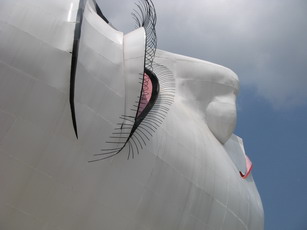
This Buddha, "Zinathuka Yan Aung Chantha" is being constructed in south Myanmar and is reputedly the world's largest reclining Buddha. It is at Mudon, in Win Sein Taw Ya Forest, about 29 km south, 20 minutes drive south of Mawlamyine (Moulmein) in Mon state. Never having seen a hollow Buddha before I was a bit bemused by the whole thing, just the fact that you can go inside and walk around the different levels, and look out of the windows in Buddha's nostrils etc.


view from the entrance

A Buddha being painted
20 minuntes later it was finished
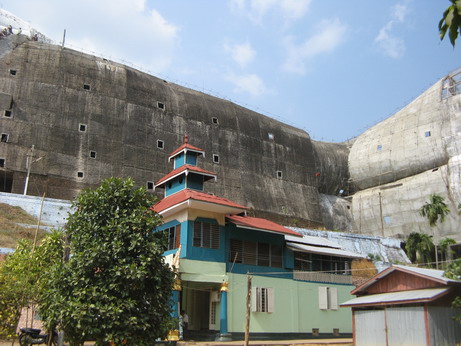
 It is said to be 180 m long, and nearly 34 m high. Inside are 8 storeys, containing about 182 rooms. The Buddha is resting against the hill, so is not easy to see from a distance. The hillside already has several Buddhas and hundreds of chedis and pagodas, including one large standing and one large seated Buddha, and down the road they have just started the contstruction of a huge Buddha sitting in a rubber plantation.

As you turn into the area, there is the inevitable line of stone monks collecting alms alongside the road.

However these don't go up to the new Buddha, but turn off half way and apparently will go all the way up the hill to the top, where the monastery is. This is where the chief monk resides.

Steps lead upto the entrance area, and more steps lead to the main hall inside.

entrance hall

lower level
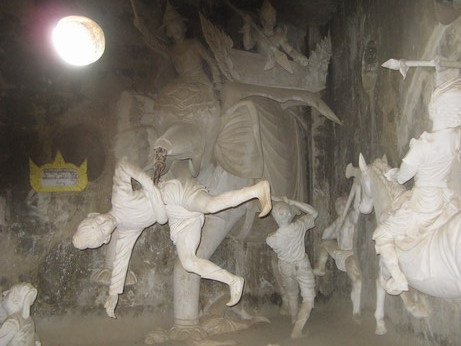
Even though it is a construction site you still have to remove your shoes to enter. Inside are 8 storeys and staircases connect them. Each level has lots of rooms, each packed with statues depicting scenes from Buddhism, but few are finished yet.

scenes from hell

 I went up and up and eventually I reached the upper level.

ooking out along Buddha's stomach

the back side, looks like an old fort
It felt like being in the inverted hull of a ship with the small windows. I reached the apex of the top level and found a small hole which the workmen were using to gain access to the outside -

 It was rather alarming to see the cracks in the pillars and ceiling and to see the poor workmanship. There are no safety barriers for visitors or the workmen.

I love the eyelashes


note the windows in the nostrils


note the standing Buddha on hill
The statue was started around 2000, but progress has been slow. One problem is the lack of water in the dry season for concrete. There is still no electricity inside.
lots of windows


© Liz Price
No reproduction without permission

Thursday, February 12, 2009

KLIA woes

I flew in and out of KLIA on my recent trip to Myanmar. My flights were eventful, thanks to the lack of maintenance at KLIA !

My flight from KLIA was delayed slightly, as a wheel fell off the luggage loader and they couldn't move it away from the plane. After some time they managed to get it far enough away, so the plane could move. Even after my plane had taxied out and was taking off, I could see the maintenance men still looking at the wheel.


On arrival back to KLIA disembarkation was delayed as the passenger bridge wasn't working . We just had to sit and wait until they could connect the bridge to the plane. Luckily the aircon wasn't switched off.

This photo is just to show the colourful MAS plane that was almost empty. I sat at the back and as you can see, I had about 70 empty seats to myself.
© Liz Price
No reproduction without permission

Jaga kerata


Jaga is cleaning the car window

The Star Metro on 5 Feb 2009 posted an article about the return of the jaga kerata. These are the illegal car parking attendants who collect a fee from people, and in return will guard your car, and some may even 'clean' your windows. Malaysians are scared that if they don't pay these men, then their car will be damaged.

I was at Bukit Bintang on 20 Jan 2009, and spent some time watching one jaga kereta. He was "working" at a parking area of about 8 cars, though I think he may also have covered another one across the road. I watched him trying to get people to park in his area whenever there was an empty space. Then when the car parked, he would take a rag out of a plastic bag and wipe the car windows. Most drivers would hand over some money when they left their vehicle. The others paid as they were leaving, and then the jaga would help the car to back out into the road.


They are found all over KL. According to the Star, drivers are paying RM2-5 for their car to be protected. That's a pretty good income for these jaga kereta!

Sunday, January 25, 2009

Borneo pygmy elephants

Published on The Brunei Times (http://www.bt.com.bn/en)

Into the Kinabatangan jungle in search of Borneo pygmy elephants


In isolation: Borneo pygmy elephants in the wild.

Pictures: Liz Price

Sunday, January 25, 2009

ON ONE of many visits to the national park, Taman Negara, in Peninsular Malaysia, I was really excited to see a solitary elephant in the wild. I was also quite scared to be so close to this huge pachyderm, as I was alone.

So you can imagine my delight when I went to the Kinabatangan River in Sabah, Borneo, and saw a whole herd of elephants. In fact we were able to get so close that we could see the wrinkles and hairs on their hide.

These were the Borneo pygmy elephants. Although elephants have been known in Sabah for some time, it was only in 2003 that it was reported they are possibly a subspecies of the Asian elephant.

There are different ideas about their origin on Borneo, and suggestion says that the elephants are a remnant population of a domesticated herd abandoned on the island by the Sultan of Sulu in the 17th century. Others say they were brought to Brunei by the British Borneo Company to help with the logging activities.

The elephants were known to be smaller than the normal elephants in Asia, but DNA analysis carried out in 2003 proved that the pygmy elephants were genetically distinct from other Asian elephants. They are likely to belong to a new subspecies.

The DNA evidence showed that these elephants were isolated about 300,000 years ago from their cousins on mainland Asia and Sumatra. During that period, they became smaller with relatively larger ears, longer tails and straighter tusks.

They are officially named as Borneo pygmy elephant, (Elephas maximus borneensis). Sadly they are already recognised as an endangered species, and although their population is not known, it is estimated to be less than 1,500. Most of these live in Sabah, in lowlands and valleys. They are endangered due to loss and fragmentation of habitat, poaching and culling for their ivory, and other body parts.

So I felt quite honoured to be able to see them at such close quarters. Not all tourists are so lucky. The elephants are migratory and need a huge area of natural habitat to live and breed. So the elephants are only in one place for a short time before moving on.

Quite often when tourists go to the banks of the Kinabatangan to look for the elephants, they are disappointed as these creatures are many miles away. The guide told us they are only seen about five to six times a year.

Normally they try to avoid humans, due to their shy nature. Due to the loss of their natural habitats, they have to pass near populated areas and plantations, and along the banks of the Kinabatangan.

The elephants have a gentle nature and don't seem to mind the presence of gawping tourists equipped with cameras. Although they are the same colour as the Asian elephants, the pygmies have longer tails and are very appealing with their babyish faces and rotund shape. Asian elephants are smaller than their African relatives.

Borneo pygmy elephants are forest herbivores. One adult can eat up to 150kg of vegetation per day, feeding mostly on species of palms, grasses and wild bananas.

They love durian and will roll the entire fruit including spikes in mud, then swallow it whole. They also appear to require supplementary minerals, which they obtain from salt licks.

Elephants live in a matriarchal society, led by a female in small groups of around eight individuals, although larger groups can be seen gathering in open feeding grounds, particularly on riverbanks.

Family groups consist of the females and immature males. Sometimes an adult male can be associated with a herd. When not in a herd, adult males usually remain solitary. They sometimes gather in small but temporary bull herds.

The group I saw consisted of about 15 animals and there were several babies with their mothers. There were four more further away, and yet another group in the woods in the distance.

Even though we made quite a noise scrambling up the river bank from the boat, the elephants stayed put and continued feeding although they did trumpet at our arrival.

The elephants need contact with other family groups to maintain genetic diversity for their evolution and survival. These animals live for up to 60 years in the wild and more than 80 years in captivity. One calf is born at a time and female Asian elephants have about seven calves in a lifetime.

This means they give birth about every four to six years if environmental conditions are favourable. The gestation period is between 19 to 22 months, almost two years, more than twice as long as human babies!

Soon after these pygmy elephants were declared to be a new species, some were captured by traders and were almost exported to zoos in China and Japan. Fortunately the authorities stepped in and banned the export of pygmy elephants.

These pachyderms will only survive as long as their habitat lasts. Large-scale agriculture is encroaching onto their territory as well as deforestation and development. Shrinking forests have also brought the elephants into more contact with people, increasing human-elephant conflict.

Let's hope that these animals, which are one of the last major discoveries in the animal world, will be able to survive and continue living successfully in Borneo.

The Brunei Times


Sunday, January 18, 2009

rubber, Ridley & Low

Published on The Brunei Times (http://www.bt.com.bn/en)

Rubber in Malaya began with Hugh Low

Rubber cultivation: Rubber processing unit; rubber mangle rollers; tapped rubber trees. Although rubber has been in Southeast Asia for more than 150 years, the tree originates from the South American continent.Picture: Liz Price

Sunday, January 18, 2009

RUBBER is one of the most important commodities in Southeast Asia and is an important natural resource for export. Rubber has been in the area for more than 150 years, however the rubber tree is not indigenous as it originates from the South American continent.

If you ask people about how the rubber industry arrived in Southeast Asia, they will probably mention the name Ridley. Henry Nicholas Ridley (1855-1956) is often called the "father of Malaysian rubber industry". Although Ridley well deserves the credit for promoting the cultivation of rubber as a commodity, it was actually Sir Hugh Low Jnr (1824-1905) who introduced South American rubber to Malaya some ten years before the arrival of Ridley.

Low had a distinguished career in government service, but is also remembered for many botanical achievements. His father, Hugh Low Sr, ran a nursery near London and in 1844 sent his 19-year-old son to Malaya and Borneo to collect plant seeds. This was the start of extensive botanical studies, beginning with orchid collections from Johore.

Low Jr then went to the Riau Islands where he collected Pitcher plants (Nepenthes) as well as nutmeg, mangosteens, butterflies and animal skins. From Riau, he moved on to Borneo where he discovered many new species of Nepenthes, orchids and rhododendrons. Because of Low's efforts, orchids became a specialty in his father's nursery.

In 1847 Low was made Governor of Labuan and became Consul-General for Borneo. He stayed in Labuan for 27 years. Then, following James Birch's assassination in November 1875, he became British Resident in Perak in 1876. He remained in Perak until 1889 when he retired and returned to England.

During his years in Malaya, Low maintained a keen interest in economic horticulture, conducting experiments with coffee, cinchona, pepper, tea, sugar, rice and rubber. He is remembered for the introduction of the Balinese pomelo, and Jersey and Alderney cattle into Malaya. And of course rubber.

There are differing stories about how rubber left Brazil. One says that in June 1876, 70,000 seeds left South America — about 1,900 of those plants went to Ceylon, others went to Singapore but were dead on arrival and the rest went to Low's nursery. The following year more went to Singapore, where they did well.

Another report says that in 1876 the first seeds of this tree were smuggled out of Brazil by Henry Wickham and brought to Kew Gardens in London, where they were planted. About 22 seedlings were sent from Kew to Singapore. It was probably Low himself who took the 1877 batch to Singapore. He had gone to England in 1876, soon after the seeds arrived there and began to germinate.

In October 1877 Henry Murton of the Singapore Botanic Gardens took 10 Hevea brasiliensis plants which had been obtained from Ceylon to Kuala Kangsar in Malaya, and 9 of these were successfully planted in the Residency garden. Low probably accompanied Murton, as it is Low who is accredited with introducing and planting the first rubber in Malaya.

The seedling flourished, grew into healthy trees and in their turn produced seed. In February 1879 Low reported his trees to be 12 to 14 feet tall. In 1880 a tree flowered, aged two years. From then on, Low continued to collect and propagate the seedlings, and make test plantings in different parts of the state.

He obviously saw the economic importance of the new crop. The vulcanisation of rubber had already been discovered, in Brazil in 1839.

Whilst in Perak, and even before that in Labuan and Borneo, Low had been looking into indigenous Asian rubbers, but the South American type turned out to be much better. Low visited England in 1884-1885 and left his stand-in, Swettenham, with 400 seeds to plant out. It was these seeds which ultimately produced the trees for the rubber plantations of Malaya.

Ridley meanwhile had arrived in Singapore in 1888, where he took up the post of Director of the Botanic Gardens, from 1888-1912.

He was proud of the small collection of rubber trees and continued the planting of rubber and initiated the first really successful tapping in 1889.

Ridley was the first man to conceive the possibilities of plantation rubber as a prosperous industry, and he used to visit the coffee-planters and urge them to plant his seeds. One of his first recorded visits to Malaya was in 1889 when he went to Batu Caves and the nearby coffee plantations.

Some planters took them as curiosities. Few planters however took Ridley seriously, and among the planting community, he was generally referred to as "Mad Ridley".

Ridley acknowledged Low's work in horticulture when he wrote in 1911, "Sir Hugh Low was indeed a great agriculturalist and must rank next to Raffles as the greatest man we have had there".

So in fact both Low and Ridley contributed hugely to setting up the rubber industry in Malaya, and both should be remembered for their respective roles in making this natural resource such an important part of the area's economy.

The Brunei Times


recycling in Malaysia

I save a lot of my household items - newspapers, magazines, glass and plastics - and take them to the recyling centre. For me it is easy, as the recycling centre is in my local shopping mall so I can drive there. Last week I took 70 kg of items. And they pay you! Of course the pay is very minimal, but it encourages people to do their bit for the enviroment.


So I was interested to see this piece in The Star, as it refers to the recyling centre I go to. It's incredible to know they collect 5 tonnes a DAY.
TheStar
Thursday January 15, 2009
Tonnes of recyclables sent to mall

By BAVANI M

THE next time you are planning to shop at Mid Valley Megamall, don’t forget to bring your recyclable garbage, that is, because you can exchange them for some cash as well as protect the environment.
An advocate on recycling and preserving the environment, Mid Valley Megamall started the recycling counter at Level P1 South Court about eight years ago whereby tenants and shoppers, including those working at the eight office buildings surrounding Mid Valley City, were encouraged to bring items for recycling.
“The programme worked so well that today we collect over five tonnes of recyclable materials every day,’’ said head of housekeeping and parking at Mid Valley Megamall, Amirul Adnan.
“People who hear about it come in armed with boxes, newspapers, magazines, mineral water bottles, batteries and basically everything that can be recycled. Even our shoppers started doing it,” Amirul said, adding that many would come in during the weekend to drop off their recyclable garbage.
The programme is being managed by Alam Flora .

Wednesday, January 14, 2009

Truly Asian Indulgence

My friends laughed when I said I was going to an afternoon of fashion and make up. Normally I wear Tshirt and shorts and never use make up. But as I had an invitation to attend the event, I decided to accept.


The event, exclusively for ladies, was hosted by Suria KLCC and held in Spring Garden Restaurant on 4th floor of Suria. The CEO of Suria KLCC made the opening welcome speech, and about 70 ladies attended. Poor guy, being faced by a sea of women, he made his escape as soon as he had spoken! Drinks and small nibbles were served and we watched a skin care demo by SHISEIDO. This was actually a girl making up a model, and as I never wear make up, it was all alien to me!!!


High tea was next, and this turned out to be a full scale buffet. The restaurant serves Chinese food and dim sum and we all piled our plates high. The food was good, loads of prawns in different styles as well as lots of other dishes.

Whilst we were eating there was a fashion show by Ang Eng, Dewi Moon and Salabianca, which are designer shops in Suria KLCC. The models of course looked great, but I wondered how the clothes would look on us mere mortals. The fashion show was done to a very catchy song "Chop Suey". And Salabnianca's collection was entitled Dim Sum Drama.


The event ended with about 8 prizes (shop vouchers of RM500 etc),we were asked questions about Suria KLCC and first person to put up their hand could answer. It was a bit chaotic with dozens of people all with their hands in the air. I won nothing, as I don't really know the shops. But we were all given a gift bag on leaving, full of beauty products. Only problem is I don't know what most of them are! What the heck do you do with "super refining essence" or "intensive skin corrective program".
-------------
© Liz Price
No reproduction without permission