Enjoy!!!

Enjoy!!!

Wednesday, August 6, 2014

Pangolins in Malaysia

As far as I can remember, I've only seen 2 wild, live pangolins in Malaysia. I quite often read news reports about van loads of pangolins that have been captured from the wild and are being taken somewhere where they will end up on dining tables, either in local restaurants or overseas. There is a huge demand for pangolin meat. It is not just the meat however, as the scales are also used in Chinese medicine.

The Star on 4 August 2014 had a distressing report, taken from The Guardian, "Pangolins: Eaten to extinction",

Pangolins are only found in Africa and Asia, and Malaysia has just one species, the Sunda pangolin, Manis javanica. Pangolins are the only mammals to have scales. They roll into a ball when threatened to protect the soft underbody. Their diet is mostly ants and termites.

The Malayan pangolin is now on the IUCN Red List as Critically Endangered.

The first pangolin I saw was crossing the road at night time. We managed to stop the car in time for me to jump out and take a photo as the pangolin disappeared into the bushes
 
Note the long tail, which is prehensile so the animal can grip trees and branches when climbing. At the other end is a long pointed muzzle.
 
My second sighting of a pangolin was during day time in 2007. The animal was in a small public park. There was a group of us so we probably made quite a noise and the pangolin soon rolled into a protective ball


We caught it and after taking photos we took it to a quieter area where we released it


© Liz Price
No reproduction without permission

Tuesday, August 5, 2014

Haze 2014 part 2

By the end of July and early August the haze was bad - at least it wasn't so much the haze but the stink of the air. It really smelt of acrid burning. I had to have the windows and doors closed which was horrid. Aug 5 was the worst day so far.

Normally Indonesia is always blamed for the haze but it is a known fact that local burning also contributes to it. This was stated in The Sun on 6 Aug :

"Local contributor to haze

Factors occurring within the country may be contributing to the current haze situation.
Figures from the Department of Environment on Aug 4 show that there have been 4,427 cases of open burning this year, with the highest number in Selangor.
These comprise fires at forests, construction sites, landfills and open burning by individuals.
The air pollutant index (API) reading in Port Klang reached a peak of 116 today while 31 areas registered good air quality and 19 other locations had moderate readings.
"The high API in Port Klang is most likely due to opening burning near the area," said Meteorology Department scientist Mohd Hisham Mohd Anip.
A change of wind direction from south-west to east-west is also expected later in the week, he said.
"The change of wind direction will be a good sign as it will blow away the smoke coming from Indonesia and haze will be reduced," he added.
As of Aug 4, there were 18 hotspots in Sumatra, 42 in Indonesia and 33 in Kalimantan.
In Malaysia, there were 24 hotspots in Sarawak, 17 in Sabah and one in Selangor.
All the hotspots in Malaysia will be investigated, Natural Resources and Environment Minister Datuk Seri G. Palanivel said in a statement."

----------

See Part 1 for the first 6 months of the year.

Monday, July 28, 2014

Crete - Spinalonga & Agios Nikolaos

From Gouves, we did a day trip to Spinalonga. We went to the jetty at Elounda, this is a coastal town with very expensive resorts.


Spinalonga is very close to the shore, and is a natural island guarding the bay. There were lots of tourist boats and hundreds of people. Tickets €2, then there was a long queue to get in as only 1 person was colleting the tickets.

Spinalonga is Venetian fort dating back to 1579, built to defend the town from the pirate raids.
There were 40 cannons. It is supposedly the best preserved walls in Europe.  After the Cretan war in the 17th century, Spinalonga remained under Venetian control before falling to the Turks.


In more recent times the island was used as a leper colony from 1903, using the old Ottoman settlements, and the mosque was converted into a hospital. Many buildings were demolished in the 1970s, but the ruins of the cobbled market street with shops, the hospital and small houses can still be seen. It is being renovated but they are using concrete rather than cobbles for the pavement.


old cobbles
cemetery for the lepers
 
The lepers had medical help and economic support and lived independently and married and had children. Care was provided for those seriously ill. ‘Who pays the ferryman’ was supposedly based on the ferryman between Elounda and the leper colony. There is a book called ‘The Island’ about the leper colony.
 
Views from the island-


Spinalonga means long spike and actually describes the long island next to Spinalonga. We went around this island and had a BBQ lunch on the boat at Kolokytha beach. I found the water very cold, supposedly 23C.


the fish look silver in the sun & dark in the  shade
 
 From Elounda it was a nice drive high above the coast to Agios Nikolaos.
 
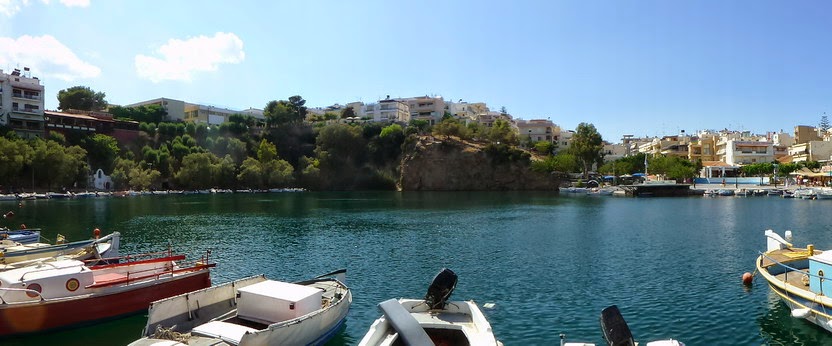
I was expecting a small village but it is larger, reminding me of Monte Carlo as it is built along the ‘harbour’ of the Gulf of Mirabello. There are pavement cafes and expensive jewellers etc. We went to a cafe by lake Voulismeni. There is a tiny chapel, though I couldn't work out if it is a chapel, or refuge for sailors in the past, or what!
the lake


© Liz Price
No reproduction without permission

Crete - Lassithi plateau & Dikti mountains

Whilst staying in Gouves in northern Crete, I did a day trip to the Lassithi plateau. This is a large plateau in the hills to the south of the Gouves area.

The first stop was a monastery. High in the hills on the way to the Lassithi plateau is the old Monastery of Kera Kardiotissa. It is dedicated to the Virgin Mary and is run by nuns and known locally as Little Lourdes and people do pilgrimages here. A nice old church but no photos allowed inside. There are antique Byzantine hagiographies (icons). €2 entry.


View from the monastery


a nun


We then went higher and stopped for lunch with a view down onto the plateau -

 The pork and potatoes looks simple but was really delicious


We went down to the plateau. I really loved the geology, the almost bare hills, some covered with small stones. The Lassithi plateau is a large plateau 850 m high surrounded by the Dikti mountains. It may be an old volcano crater. The water drains out through a tunnel at one end, though I'm not sure if this is natural or manmade. There are/were 10,000 windmills, used for irrigation, although strictly speaking they are wind pumps rather than mills.
 

There are a few potters and pottery shops up on the plateau. However the clay comes from elsewhere and it brought up to the shops


The tour included a visit to Dikte Cave, see separate blog


View down to the coast -


© Liz Price
No reproduction without permission