Enjoy!!!

Enjoy!!!

Saturday, January 29, 2022

Sloth and other animals in Costa Rica

 Whilst in Costa Rica in Jan 2022, I was really excited to see my first sloths in the wild. I had seen some a couple of years earlier in the Amazon, Brazil, in Jan 2020, but those were captive ones. See my blog on Boca de Valeria, Amazon.

So it felt more special to see my first wild ones. We were on the east coast side of Costa Rica, i.e. the Caribbean. We started our boat ride on the Tortuguero Canal, and went up the Rio Moin which leads to the Rio Bartolo. The Tortuguero Canal is a National Park and conservation area. The sloths here are the three-toed sloths, which are arboreal neotropical mammals. They are Bradypus variegatus. Sloths are the world's slowest moving mammal.

The first sloth was quite well hidden in a tree and it was difficult to get good photos. With the brown fur that is tinged green, it was well camouflaged. Sloths fur is generally tinged green which is due to algae.


That was the best shot I could get so I was really pleased later on when we saw our second sloth and got a really good view. It was on a branch by the water and climbed down until its backside was touching the water then sat there for a while, before climbing back up. Sloths are very good swimmers but are incredibly slow in trees.

Here is it starting its descent to the water.


Here you can see the 3 digits on the upper arm, although one is almost invisible in the sunlight -


It eventually makes it down to the water level and sits there contemplating what to do. Its head is looking directly into the water -

Someone then spotted a cayman (caiman) so we moved off to see that -

When we got back to the sloth, it had climbed back up the tree -

The facial structure of a sloth gives the appearance that it is constantly smiling 

Video of the sloth in action -


Costa Rica has 4 species of monkey. We saw one, having a snooze high in a tree. It is a mantled howler (Alouatta palliata). It is is one of the largest Central American monkeys and spends the majority of each day resting and sleeping. Leaves make up a lot of its diet.

We saw lots of birds along the river. Yellow-crowned night heron, vultures


Various iguanas -


There is a Costa Rica sloth sanctuary nearby, so my sighting of wild sloths felt more exciting knowing again that these were wild creatures rather than in any form of captivity. 

Monday, December 13, 2021

Royal Andalusian School of Equestrian Art, Jerez, Spain

My last blog was about the Lipizzaner stallions of Vienna. I saw the world famous Lipizzaner horses perform in Wembley in Nov 2016. In Oct 2021 I was in Vienna and went to the Spanish Riding School stable which was the highlight for me. Then a few days later I was in Budapest and did a tour to a horse centre on the Great Hungarian Plain and saw a show which included the Lipizzaners.

So having seen them in London, Vienna and Hungary, I was happy to see them in their native land in Spain. In Dec 2021 I was in Cadiz in southern Spain and had the chance to go to the Royal Andalusian School of Equestrian Art. This is located in Jerez, not far from Cadiz. Jerez is famous for the horses and also sherry.

The Royal School is famous worldwide for its year-round performances of “How the Andalusian Horses Dance”. The shows are on a Tue and Thur, and last 90 minutes.


I didn't know the difference between Andalusian and Lipizzaner horses. It seems the Andalusian are the breeding stock to create the Lipizzaners and others. The Andalusian, also known as the Pure Spanish Horse or PRE (pura raza espaƱola), is a horse breed from the Iberian Peninsula, where its ancestors have lived for thousands of years. The Andalusian has been recognized as a distinct breed since the 15th century, and its conformation has changed very little over the centuries. Throughout its history, it has been known for its prowess as a war horse. It has been used in the development of many other breeds around the world including the Lipizzaner. Can be seen as white, grey or black but other colours also exist.

Before going into the show we had time for a quick look around outside. Several horses were undergoing training.


I took this photo for 2 reasons - firstly the Sandeman name and logo. Sandeman is a brand of Port and Sherry wines founded in 1790. Its well known logo features a caped man named Don dressed in a Portuguese student's cape and a wide Spanish hat. Secondly there is a large nest on top of the chimney. I assume it is a stork nest. 


There are orange trees in the grounds, they are also common along the streets of Cadiz and Jerez. They are the bitter or Seville oranges, widely used for marmalade. 

We then went in for the show. There were 1200 people and there weren't that many empty seats. Each dance was quite long, performed by a single horse or several. It is quite incredible that the horses can perform such unnatural steps and "remember" such a long routine. We also saw a horse canter then come to a dead stop. 


The audience had to wear masks -


This horse did a long dance routine on the spot, and kept perfect time to the music.

This horse looks so elegant as it dances -

Best of all were the horses that could stand on rear legs and actually jump into the air. Quite a feat considering the body weight. This horse is airborne, all 4 legs are off the ground -


This one also has all feet off the ground -

There were also displays of carriage driving -

There was a short break and I went outside to warm up, as it was cold in the arena. 

The finale -


I started my last blog referring to Mary Stewart's book "Airs above the ground". Airs above the ground are the movements where the horse actually leaves the ground, as seen above.

I thoroughly enjoyed the show and wonder just how the horses are trained to do such complex moves and such long routines.

There is a lot of information about the history and the dances etc on this site.


Wednesday, October 27, 2021

Lipizzaner stallions of the Spanish Riding School, Vienna

 One of my favourite books as a teenager was Mary Stewart's "Airs above the ground"as part of the story features the Lipizzaner stallions of the Spanish Riding School of Vienna. For some reason these horses stayed in my mind as an adult. I used to ride horses, but just simple riding, nothing such as jumping or dressage. 

My first visit to Vienna was in 1983, but somehow I missed seeing the stables of the Spanish Riding School. So when I was back in Vienna in October 2021, I was really happy to get to the stables.


Normally the horses do shows in many countries, but of course that all stopped with the covid pandemic. We were told that they really missed the crowds and having an audience. 


We were lucky as whilst we were there, a few of the horses were led out -


The Lipizzaner horses are born grey or black and the coat gradually lightens over the years, they become white after 6 - 10 years, although it is not a pure white. Only the stallions are used in Vienna’s Spanish Riding School. Read more on the history of the stallions.

In 2016 I went to the SSE arena at Wembley in London to see the 450th anniversary tour of the Spanish Riding School of Vienna. 


After visiting Vienna in 2021, I had another encounter with the Lipizzaner horses in Hungary. I was on a tour to the Lovascentrum horse centre, which is an hour's drive on the M5 southeast of Budapest. It is on the Puszta – the Great Hungarian Plain.


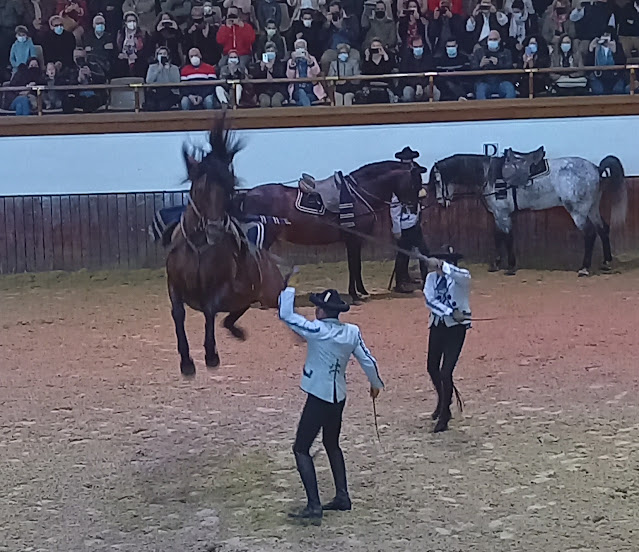
The blue-robe-clad Csikos (mounted horse-herdsman) perform a horse show. Note the long whip.


Firstly we watched a group of horses galloping around the enclosure. You can see the different colours indicating the different ages - 


Then we saw different carriages -


A man demonstrated his skill standing on two horses whilst the group galloped around -


A horse lying down whilst the handler cracks the long whip around the horse -


It was quite amazing to see a horse sitting like this -


Even the albino mule was able to sit -


Hungarian grey cattle 


We then went for a carriage ride. After that, we visited the stables -


We then saw more cattle, donkeys and mules and other animals -


It was fascinating to see the Lipizzaners in a different setting.

***

UPDATE

In Dec I went to a show at the Royal Andalusian School of Equestrian Art, Jerez, Spain. This was another amazing chance to see the horses perform their dances etc.

The famous Lipizzaners are now bred especially for the Riding School at the Piber Stud Vienna. These Spanish horses are best suited to the equestrian arts. The Lipizzaners can come from other stock apart from the Andalusian.