These blogs are my non-cave photos and stories. The older ones are taken from my Multiply site, which closed in March 2013. I have a 2nd blog for the SE Asia cave items and a 3rd blog for non SE Asia caves.
The annoying parakeets are back, feeding on young shoots in the morning and evening. They are a bird I detest simply because they are so noisy, constantly chatting very loudly. I am thankful they don't live near me. I really notice them in places such as Cator Park, where they are constantly flying around and chatting loudly.
In June 2020 there was an abundance of the parakeets in trees very close to me. I saw them in the spruce tree, eating the young shoots. I blogged about this in 2016, "Parakeet eating young conifer shoots". They would arrive in the morning, hang around for part of the day, and then be very vocal again in the evening, before flying off. They seem to have arrived earlier this year, probably around 10 June.
Thankfully by 22 June only one or two were around. Presumably whatever food source had attracted them earlier had now dried up.
In 2020 they were about 2 weeks earlier than they were in previous years.
___
UPDATE
The parakeets returned around Aug 7, arriving in the morning and evening for short periods. Thankfully they had virtually gone by the 19th. I'm always scared that they will move in permanently!
___
ANOTHER UPDATE
The parakeets were around end of Sept for brief periods in morning and evening, but in small numbers.
__
Ring necked parakeets need trees for roosting. Their feet are not made for perching on ledges like pigeons. They breed in tree hollows.
----
2023
In June the parakeets were back, eating the young leaves etc on the trees close to me. Unfortunately they didn't go away after a few weeks as they have done in the past. Quite a few stayed. Every morning and evening they sat in the trees and chattered, then would all fly off noisily in the evenings. I didn't really hear them during the day. I'm hoping they will go once the leaves have fallen.
Foxes are carnivores /omnivores and their diet would naturally include birds and small mammals.
However the urban foxes must be sufficiently well fed that they have no interest in preying on birds.
In fact the foxes, squirrels and pigeons all feed together.
In this photo the pigeons are on a box, but sometimes they are on the ground close to the fox. And the squirrel doesn't feel trapped by the adult fox.
This photo taken in June is a fox cub who is ignoring the pigeon on the ground. When I first saw the cubs in mid May they would chase the pigeons.
I've noticed that the squirrels and pigeons were initially wary of the young fox cubs, so at least they haven't completely lost their fear of foxes. And the young cubs initially do chase the other animals, so this prey instinct is part of their nature.
This is an older photo of a fox and cat ignoring each other
The only animals that object to the foxes are the crows. They start cawing loudly when a fox is around, but all the other creatures ignore them.
The pigeons and squirrels amuse me as it's usually a race to get to the peanuts that I throw out. Sometimes they both go for the same nut then both back off. Once they collided and the squirrel knocked a few feathers out of the pigeon!
However the pigeons aren't always safe from the foxes. Last year I posted about a pigeon that was attacked, probably by a fox cub - see "Fox cub and pigeon".
I often go to Horniman's Park and enjoy seeing the alpacas. The heat returned in the later part of May. The lockdown rules had been relaxed and Horniman's was full of people enjoying the good weather.
Even Peeps the alpaca was sunbathing, but she must have been hot in her black coat. The sheep was looking on in amazement!
She eventually sat up
Poppy the daughter was close by all the time -
They both had haircuts a few weeks ago. Poppy had been left with more leggings and bootees than mum.
Every year I eagerly look out for the new fox cubs. I usually see them in mid May. This year, 2020, I knew they were around as 2 mothers were taking food back to them and I could occasionally hear some squeaks. And prior to that one of the mothers who I see frequently every day disappeared for a few days, presumably when she was giving birth. I've named her Manky Tail.
I was really happy on the evening of 12th May to see the first 3 cubs. This was the earliest I have seen them, as in 2019 it was 17 May, in 2018 on 17th, and 2017 on 15th May. So the dates have been consistent over 4 years.
Manky Tail has 2 cubs. She is not at all worried about bringing the cubs for food. Whereas the other mother, White Tip, is much more timid. I'm not sure if she has 2 or 3 cubs as I only ever see her with 2, but there are 3 in the 3rd photo below.
I live on the first floor so it's not easy to take good photos and with the cubs running around it is even more difficult.
The first cubs I saw on the 12th were White Tip's. There were 3 of them.
Next day I saw this one,
I didn't see White Tip with her cubs again for a few days. It wasn't till the 15th that Manky Tail brought her cubs for food. It was a sunny morning and the light was bad for photos. Kissing mum then sniffing her bum! -
Mum went off to bed leaving the youngsters exploring their new world. They were still checking things out at 1.30 pm. Sniffing some bread then lazily eating it -
The sibling also eating lying down -
Both exploring -
Manky Tail again
UPDATE
Having said that Manky Tail and White Tip are the mums, I don't actually know what sex they are! It is very difficult to tell the sex of a fox. And it's harder for me as I am looking down on the foxes from the first floor, so can't see them from 'underneath' to see their genitals. If these 2 foxes are the mums I would expect to see teats from nursing.
And the fact that these 2 adults were taking food back to the den could mean they are the males, helping the mother who is staying in the den with the cubs. From newforestexplorersguide :
"Fox gestation period is around 52 days, births are usually in March or April, and the typical litter size is 4 or 5 cubs, although in the New Forest, litters of 6, or sometimes more, are not uncommon. Fox cubs at birth are blind and deaf, their nose is relatively short, their ears are small and floppy, and their fur is short and very dark. The vixen’s body heat is needed by the cubs for the first 2 to 3 weeks of life - during at least the early part of this period, she is provisioned by the male: he leaves food by the den entrance for her. After around 4 weeks, the cubs first venture above ground, hesitantly initially. By this time, their coat is darkish brown with a reddy tinge to the face, their ears are more like those of adults: longer and erect; and their muzzle has lengthened and will continue to do so as adult facial features are progressively developed over the next 4 - 6 weeks. Adult coat colour is also fully assumed over this period, starting, at least in some animals, at the front and working backwards. Following first emergence, hunting and foraging instincts quickly kick in as the cubs seek out earthworms and insects to supplement a mixture of 'mother's milk' and solid food brought back for them by both the dog fox and vixen. Relatively large mammals, such as rabbits, and birds are often provided for the cubs, whilst for themselves, the adults apparently favour smaller prey items, such as mice and voles."
Over the past few years that I've been following the foxes, I've never seen both mum and dad with the cubs.
---
UPDATE 1 JUNE
Concerned as I haven't seen Manky Tail with any cubs for about 2 weeks. I've only seen 2 cubs with White Tip. And whereas those two adults used to get along peacefully, last evening WT went for MT who was eating, forcing MT to drop the food and run, then lie submissively, whining. It's frustrating not knowing the sex of those adults.
Typically after I wrote the update on 1st, I then saw the 2 adults and 3 cubs.
I woke up around 4 am on 13 May 2020 and looked out and saw an impressive moon. It is in its third quarter and waning gibbous (this intermediate moon phase comes after the full moon and lasts until half of the Moon's surface is illuminated at third quarter moon. Waning means that it is getting smaller. Gibbous refers to the shape, which is less than the full circle of a full moon, but larger than the semicircle shape of the third quarter moon.
I didn't get a good photo unfortunately and the photo makes the sky much darker than it really was -
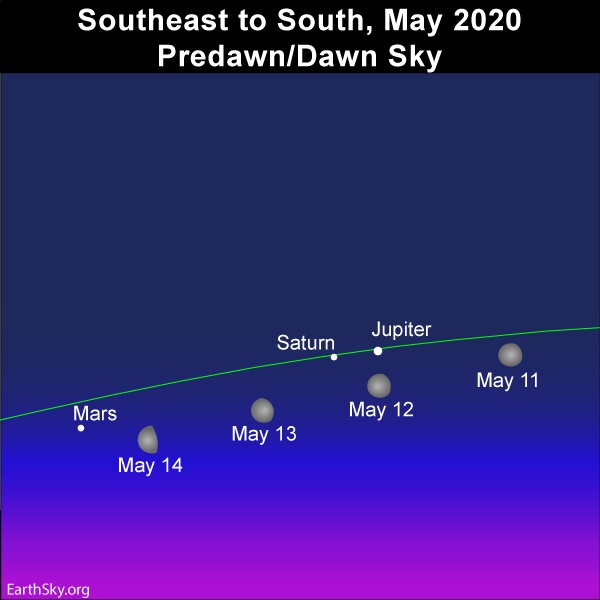
I then noticed 2 bright "stars" to the right of the moon and realised they were planets. Googled them and found they are Saturn and Jupiter.
Photo taken at 4.23 am.
Apparently Mars was also visible in this southern sky, but I didn't see it as by the time I looked for it, the sky was considerably brighter.
From earthsky.org :
"These next several mornings – May 11, 12, 13 and 14, 2020 – let the waning moon introduce you to three bright morning planets. Jupiter is by far the brightest of the threesome, beaming some seven times more brilliantly than either Saturn or Mars. Jupiter also outshines all the stars. You’ll have no trouble identifying Jupiter. Mars and Saturn are fainter, but – like Jupiter, and like the moon – follow the approximate path of the ecliptic (sun’s path) across our sky. Thus the three planets, and the moon, make a small, graceful arc across our predawn sky. Mars and Saturn are almost equally bright (Mars is a tad brighter), and there are other ways of distinguishing Saturn from Mars. First of all, Saturn shines in close vicinity to Jupiter, and these two worlds will remain close together on the sky’s dome for the rest of 2020. Find dazzling Jupiter first, and that nearby bright world will be the ringed planet Saturn any time this year. Remember … you need a telescope to see Saturn’s rings."
It is easy to see the wild Kashmiri goats on the Great Orme at Llandudno in north Wales. I've seen them a few times - see my 2017 blog.
And in recent years they often come down into town where they roam the streets feeding on hedges and flowers in gardens. Last year in March 2019 bad weather also brought them down into town, see BBC report. I was there in April 2019 and saw a few in the town suburbs, but didn't get any photos.
And they are currently in town again. At the end of March 2020 the UK was in lockdown because of the Coronavirus. The streets are really empty and quiet and the goats are taking full advantage. There have been many news reports, such as The Metro and BBC .