Enjoy!!!

Enjoy!!!
Showing posts with label Cambodia. Show all posts

Sunday, September 13, 2020

Tuol Sleng Museum, Phnom Penh, Cambodia

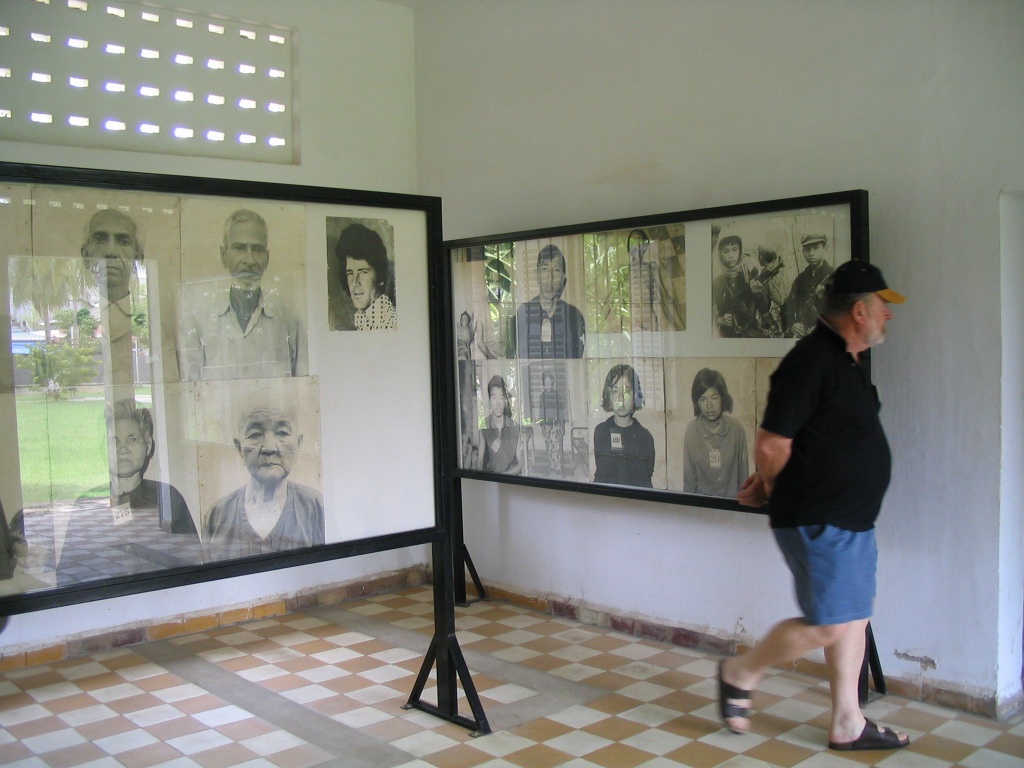
Having just published a blog on the Khmer Rouge prison chief who recently died, I realised I haven't published my photos of the Tuol Sleng musuem. Tuol Sleng was a prison outside Phnom Penh, described as the country’s largest torture and detention centre.

I visited the museum in 2004. See an article I wrote.


Photo of a body on a bed -


The gallows, 


Khmer Rouge prison chief dies, Tuol Sleng, Cambodia

On 2 Sept 2020,  the man who admitted to overseeing the mass torture and killing of thousands of Cambodians as the head of the prison system for the Khmer Rouge, died in a Cambodian hospital. He was Kaing Guek Eav, known as Duch.  He ran the regime's prison system, which tortured and killed thousands of Cambodians under his leadership. He had been serving life in prison for war crimes and crimes against humanity for his role in the totalitarian political party.

Duch became the first senior member of Khmer Rouge to face a UN backed tribunal in 2009, in its effort to deliver justice for the regime's genocidal rule of Cambodia in the 1970s. He ran the top-secret Tuol Sleng prison, was one of only a few of the regime's members who even took partial responsibility for their actions.

I went to Tuol Sleng prison museum in 2004. In my diary I wrote : 

"$2 to enter the museum, the country’s largest torture and detention centre. Prior to 1975 Tuol Sleng was a high school, consisting of 3 buildings. When the Khmer Rouge came to power it was converted to the S-21 prison and interrogation facility. People were systematically tortured, sometimes over a period of months, to extract confessions, after which they were executed at the killing fields of Choeung Ek. S-21 processed over 17,000 people, 7 of whom survived. The buildings now serve as a museum, a memorial and a testament to the madness of the Khmer Rouge. Much has been left in the state of when the Khmer Rouge abandoned it in January 1979. The prison kept extensive records, leaving thousands of photos of their victims, many of which are on display. Some of the photos were awful. Paintings of torture at the prison by Vaan Nath, a survivor of Tuol Sleng, are also on display. I wasn’t sure why some cells were made of wood, others of brick. And why the large cells on the ground floor had only one bed – unless these were the torture rooms. Prisoners were shackled to the beds. Some of the torture equipment is on display."

It is awful to think that any Cambodians who were seen as enemies of the party, or anyone that disobeyed orders, were put behind bars - with only a handful surviving. Everyone who was arrested and sent to the prison was presumed dead already. Prisoners were beaten, whipped and shocked with electricity, Duch said at his trial, but refused to admit he took part in the torture and killing himself.

As well as killing prisoners, victims' children were also executed, to make sure the next generation could not take vengeance on the Khmer Rouge. Babies were battered against trees.

Previously a maths teacher, Duch joined Pol Pot's movement in 1967, three years before a US campaign of carpet bombing began, which was an effort to take out Northern Vietnamese troops and Viet Cong inside the Cambodian border.

The Khmer Rouge took power in 1975 and quickly changed Cambodia into a peasant society, and forced people in cities into the country to work the land. Duch then headed the prison system.

After he hid in the northwest of the country and was only discovered 20 years later and he was arrested and sent to trial. He then served life in prison.

---

See more on my blog "Cambodia's Tuol Sleng Museum".

And a blog on the photos I took at Tuol Sleng Museum


Saturday, October 27, 2012

Bamboo train, Battambang, Cambodia - 2005

The bamboo choo-choo

Story & pictures by LIZ PRICE


THE STAR L I F E S T Y L E
Travel & Adventure
Saturday July 23, 2005


When asked if I wanted to ride on the bamboo train, I had no idea what was in store. The picture that came to mind was of a cute toy train with bamboo carriages.

I was in Battambang province in northwest Cambodia and had spent the day visiting the killing fields of the Pol Pot regime, as well as temples, a rice processing factory and various other attractions.


It costs just RM1 to get from one station to another on the bamboo train of Battambang

From my hotel in Battambang, I hired a motorbike and driver for a mere RM23, for a seven-hour trip.

We crossed a river using a narrow suspension bridge. This was upstream of the Stung Sangker, or Sangker River, which flows through the centre of Battambang. Despite being Cambodia’s second largest city, Battambang has a laid-back atmosphere. It is an elegant riverside town with French period architecture.

We were heading west, out of town, in the direction of the Thai border. We stopped at a wat to look at the fruit bats in the trees. The bats living here are protected by the monks. Without this protection, they would be hunted and eaten. From the wat, it was quite a muddy ride through small villages and along the river. I thought we were going back to the hotel and was surprised when we came to a railway line.

I was told this was the bamboo railway but could see no sign of a train, and there were definitely no cute bamboo carriages. I got off the bike and walked in the drizzle to the station. There were quite a few people bustling around and lots of goods waiting to be transported. I wondered how long we would have to wait for the train to arrive. I knew that the train service in Cambodia was fairly primitive and incredibly slow.

Train travel is cheap, but patience is required. The trains travel at an average speed of 20kph and unscheduled stops because of mechanical problems are not uncommon. We were on the main railway line from Phnom Penh to Poipet, the border town. The French built this single-track, metre-gauge line in the 1920s. They used it to carry coffee and bananas to the city.

The first tiny steam engines were replaced later by more powerful steam locomotives. But during the Khmer Rouge regime, the trains were destroyed. The tracks were spared but became overgrown with jungle. After the civil war, the locals cleared the rails and the line was back in operation again.


It is made up of a metal frame with bamboo slats, two axles with wheels and a motorcycle or tractor engine.

The 274km journey from Battambang to Phnom Penh takes around 15 hours. The train runs up one day and down the next day. Whilst I was contemplating the speed of the train, the penny suddenly dropped. I realised that I had been looking at the bamboo train without recognising it.

The Battambang bamboo train (or norry in Cambodian) is, in fact, a metal frame with bamboo slats that sit on two axles with wheels. It is used to transport people and goods up and down the railway.

After the days of the Khmer Rouge, the land mines were cleared from the tracks, and the local residents built dozens of these miniature trains. It was interesting to watch the contraption, 3ft (1m) x 8ft (2.4m), being assembled. Two young men appeared, carrying two steel axles with cast-iron wheels at both ends. These were placed on the track – a perfect fit.

Next, a metal frame with the bamboo slats was positioned atop the axles. The engine sits on top, linked to the wheels by a rubber drive wheel. To brake, the driver turns the engine off and coasts to a stop.

The older trains don’t have a metal frame. There is instead a long bamboo mat. The axles fit into two steel forks on the underside of the mat. The mat sits atop the wheels. The train is driven by a motorcycle or tractor engine. Gasoline is available at village crossings, sold in glass whiskey bottles. In the past, men used poles to push the train along.

It runs about 10km up and down the line, and costs 1,000riel (RM 1) between stations. As the regular train only goes up one day and down the next, there is no danger of collision.


An old French station.

However, if two trains do meet, the lighter one is simply taken off the rails to allow the other to pass.

I was lucky as one train was being loaded when we arrived. Before I really grasped what was happening, people jumped aboard and a few men started pushing it whilst running along behind. And off went the bamboo train.

The old French station would have been elegant in its day. Today, it is used as a store for the train parts. The rain continued, and somehow both my shorts and T-shirt had got plastered in mud underneath my poncho. But it was worth it as I had seen the Battambang bamboo train.

Thursday, October 25, 2012

Life around Tonle Sap - Star 2005

THE STAR
Saturday March 5, 2005
Life around Tonle Sap

Story & pictures by Liz Price

We were flying over a huge expanse of wetland and my first thought was there had been big floods recently. But then I saw that the flooded area was actually a mix of marshland and lake. It was immense.


Homes are humble here.

The plane landed in the small, international airport of Siem Reap in Cambodia, the gateway to the world-famous Angkor Wat temples. Although these temples were to occupy our time in the next few days, we visited Tonle Sap lake on our first afternoon there.

Tonle Sap is the largest freshwater lake in South-East Asia.

That afternoon we wandered around the market area of Siem Reap, absorbing the atmosphere and getting a feel of the place. There were several beggars following us, mainly amputees, victims of the landmines which have plagued Cambodia for the last decade. Others who were clamouring for our attention were the romauk drivers.

Romauks are motorcycle taxis, commonly known as tuktuk, although they resemble motorcycle trailers. They only exist in Siem Reap and are a good invention, as two people can sit side by side, and there is even shelter in case of rain.

My travelling companion, Sandy, is good at bargaining and was soon in lengthy negotiations with Sam, the tuktuk man.

Sam had been following us for a while, trying to get our business. We pretended to be disinterested and wandered back to the hotel, but he followed us. There is an abundance of romauk drivers in Siem Reap, but few tourists. Finally, we agreed on a fee of 10,000 riel (RM10) for Sam to take us to the lake to watch the sunset.

On the way, we stopped at Krouser Thmey, which is a non-governmental organisation that looks after orphans. It has an exhibition centre and the main display is about Tonle Sap lake.

Here, I learnt that one quarter of Cambodia’s population – some three million people – live on the lake. Many are poor and live in simple boathouses. It is also the richest freshwater fishing ground in the world.

As we left Siem Reap, we drove along one street lined with houses. There was so much to see, and a lot of activity too. It was my first visit to Cambodia, so I found everything fascinating. The houses decreased in size and number as we went along, eventually becoming small huts. Ahead of us was Phnom Krom. (Phnom means hill in Cambodian.)

It was Saturday and lots of locals were out for dinner or having picnics by the roadside.

Phnom Krom is 12km south of town. We parked near a bustling market. The tantalising smell of grilled chicken whetted my appetite.


An artistic display of snakehead fish.

We walked through the village, which consisted of a row of small huts on the edge of the lake. From here, the express boats go to Phnom Penh and Battambang, the two largest cities in Cambodia. Dozens of express boats were moored here.

Although the villagers are poor, they seemed happy and content, and were quite friendly. The kids said “Hello” and enjoyed being photographed. The houses were basic and small, with no electricity or running water. Clean water comes from communal handpumps.

My camera clicked furiously as I discovered a lady grilling a rat over some charcoal. I did a double take as I didn’t realise what it was. She obligingly held it up for me to photograph.

There are a few shops here, but they are spartan. We walked down to the water village. Boats were weaving in and out of the maze of stilts supporting the houses. People were selling and buying things, doing household chores or just relaxing and chatting, but many stopped to wave at us.

We visited the Gecko Environment Centre which has displays on the flora and fauna of the area as well as information on communities living around the lake.

The first item to catch my eye was a tank containing snakes. To my amazement, the caretaker stuck his hand in the tank and pulled out a fat snake and dumped it on the counter in front of me. Fortunately, the snake just sat there and made no attempt to escape.

There are six species of water snakes living in Tonle Sap. About 8,500 snakes are caught a day during the wet season. They are eaten with palm wine. The skin is also used. Apart from fish, turtles live in the lake but are being heavily hunted. The Siamese crocodiles are also decreasing in number.

About 700 families live on Chong Khneas, the name of this floating village. The people are a mix of Buddhists from Cambodia, and Catholics and Muslims from Vietnam. They live in floating houses and wooden boats, and the village “moves” with the season. Tourists need to rent a boat to see it properly.

The villagers make their own fishing nets and use lights to attract the fish. Cages are used to rear fish such as the snakehead.


Clean water comes from communal handpumps.

There are two species of fish here, the Channa micropeltes a.k.a. Giant Snakehead (toman), and the Channa striata or Common Snakehead (haruan).

These two species collectively comprise the second most important fish group bred under culture in the Mekong area. The snakehead is not a pretty fish and has some canine-like teeth, but it tastes good. We ate it several times, mostly as curry.

The Tonle Sap lake flows into the Tonle Sap river, which enters the mighty Mekong River at Phnom Penh. The 4,200km long Mekong is the longest river in South-East Asia and is the third most diverse river in the world after the Amazon and the Congo.

There are some spectacular large water bird populations, and over 1,500 fish species here. The Giant Mekong Catfish can weigh up to 300kg and is an endangered species.

Tonle Sap Lake itself is an incredible natural phenomenon. During the wet season, the waters of the lake increases from 2,500 sq km to 13,000 sq km. The maximum depth here is 10m.

This process makes Tonle Sap one of the world’s richest sources of freshwater fish and a fertile spawning ground. The fishing industry supports about one million people in Cambodia and a dry season catch on the lake can average 100-200kg a day.

Monday, October 22, 2012

Angkor's peaceful tourism (BT)


Published on The Brunei Times (http://www.bt.com.bn/en)
Venturing into Angkor's serene and peaceful tourism

A memorable place: Part of the Angkor Wat structure; the stone reliefs at Bayon. Picture: Liz Price
Liz Price
SIEM REAP, CAMBODIA

Sunday, December 7, 2008


I was surrounded by giant stone heads, each one had four faces and they were mostly wearing different expressions. I felt as if I was being watched from all angles, but it was a nice feeling as there was a sense of well-being. The heads are ancient, they have been staring out from their rocky towers for about 1,000 years.

I was in Bayon, one of the temples in the Angkor Wat group, and probably the most famous and best visited after Angkor Wat itself. The giant stone faces of Bayon have become one of the most recognisable images of the Khmer classical art and architecture.

Angkor Wat is a name known to most people. It is the name of one of the world's most famous temples, and is on a par with illustrious sites such as the Pyramids, Machu Pichu and the Taj Mahal. The millennium old temples belong to the Khmer empire. The gateway to Angkor Wat is Siem Reap, a small town nestled between rice paddies and the Siem Reap River, in the Kingdom of Cambodia.

The Angkor Archaeological Park is designated as a world heritage site and fortunately has not yet been spoilt by tourism. Cambodia has had a traumatic modern history during the brutal Pol Pot regime in the 1970s.

During this period the Khmer Rouge massacred several hundred thousand people, whilst thousands more died of famine and disease. Some estimates suggest up to two million Cambodians may have died. Even after the Pol Pot government was toppled, Cambodia had further problems with invasions by the Vietnamese and a long civil war. Few foreign visitors went to Cambodia during this period. Tourism was limited and it is only in the last decade that Cambodia is opening up, and now the country has been declared safe for tourism.

I found Cambodia to be safe and serene. The people are amazingly friendly and content, despite the appalling hardships they have been through. Cambodia relies heavily on tourism, especially at Angkor and it won't be long before mass tourism hits it.

Angkor means "Capital City" or "Holy City". It was the capital city of the Khmer empire in the 9th-12th centuries. The temple ruins in the Siem Reap area are the remains of the Angkorian capitals. There are dozens of temple ruins.

At first I was a bit perplexed as to how we would see them all, as it seemed a bit daunting. The guidebooks all suggested itineraries, depending on your length of stay, but it was all a bit meaningless initially.

So the first thing we did was hire a romauk. This is a two person motorcycle trailer and is ideal for visiting the sites. The romauks have surpassed the motorcycle taxis, as they are more comfortable and mean two people can sit together and there is plastic covering in case of rain. They are commonly known as tuktuks but do not resemble the tuktuks in Bangkok.

My travelling companion bargained hard, and after lots of discussion agreed on a price we were all happy with, 30,000 riel or US$7.50 ($11.40) a day. This was actually less than the guidebooks suggest. In Cambodia the US dollar is fully interchangeable with the local riel, and it was common to pay a bill with a mix of both currencies.

Our driver was happy to have our custom, as now there are an increasing number of romauk drivers in Siem Reap and not enough tourists to warrant them, especially in the low season.

So we set off for our first visit to Angkor. The previous evening we had already bought our passes. We opted for a three-day pass, which costs US$40, which seems horribly expensive by Asian standards, but I guess is worth it.

When a friend visited Angkor a few years ago he complained about the corruption whereby used tickets would be collected from tourists and resold to new tourists. Luckily now that has all stopped, and official passes are now issued bearing a photo of the holder, and these passes are checked at all major temples.

As we drove the 6km from Siem Reap to the temples we both had our cameras out, eager to take photos.

However we soon realised that it was quite a bumpy ride in the tuktuk and therefore not very conducive for photos. Having gone through the pass check, we drove down a wide avenue lined with large Dipterocarp trees.

These dominate the Angkor forest. We rounded a corner and I had my first glimpse of the three pyramid towers of Angkor Wat, rising above the exterior wall and trees. We motored around the massive moat to reach the main western entrance.

Angkor Wat was wonderful and we spent hours there. Over the days we also saw the other famous sites such as Ta Prohm which is really atmospheric with the giant trees swallowing the temples.

But somehow I preferred Bayon. It is much smaller with 54 gothic towers and the 216 coldly smiling faces. The serenity of these giant stone faces is etched into my mind and sums up that Cambodia has at last become a peaceful place.

The Brunei Times

----------------------------------------------------------------------------

Source URL:
http://www.bt.com.bn/en/en/travel/2008/12/07/venturing_into_angkors_serene_and_peaceful_tourism

Wednesday, October 15, 2008

Rice mill in Cambodia


When I was caving in Battambang province in Cambodia I grabbed the opportunity of looking inside a rice mill.

wooden framework


packing the rice


looks like a museum piece

Vietnam machinery

outside the mill

spare parts?

bringing out the sacks

lady scavenging husks

monks outside the mill

rice drying on the road


My article was published in the Brunei Times and I've posted it on rice mill in Cambodia.
---------
© Liz Price
No reproduction without permission