Enjoy!!!

Enjoy!!!
Showing posts with label turtles. Show all posts

Saturday, September 12, 2020

Loggerhead turtles on the Greek Ionian islands

The two Ionian islands I visited in Sept 2020, Kefalonia and Zante (Zakynthos), are both known for the Loggerhead turtles (Caretta caretta) that are found in the waters around the islands.


Unfortunately the existence of turtles around these tourist islands means they have become a big attraction for visitors, and this affects the conservation of the turtles. A similar thing happens in Malaysia, where the egg laying turtles and resulting hatchlings have become a big tourist attraction both in West Malaysia (east coast) and East Malaysia (Turtle Islands, Sabah). See my article on the Turtle Islands. The Turtle Islands are quite carefully controlled, but it's not as good in West Malaysia, where a lot of eggs end up in the local markets. 

In the Ionian Island, the turtles lay their eggs on beaches in Zante. Sadly the Loggerhead turtles have chosen the long sandy beaches between the main holiday resorts of Laganas and Kalamaki, located on Laganas Bay at the southern end of the island. And Laganas Bay is the most important breeding site for the species in the Mediterranean. It is in a National Marine Park.

The loggerheads have a wide range, and are classed on IUCN red list as vulnerable :


Unfortunately on Zante, the locals are cashing in on the turtles and doing little to prevent their gradual extinction.  It got so bad that Greece was taken to court in 2002 by the European Commission for its repeated and long-standing neglect in protection for this fast disappearing creature. See Greece: Commission continues legal action to protect rare sea turtle. "On 30 January 2002, Greece was condemned by the Court of Justice for failing to adequately protect the rare loggerhead sea turtle, Caretta caretta, on the island of Zakynthos. Laganas Bay in Zakynthos is the most important breeding site for the species in the Mediterranean. The sea turtle lays eggs only every two or three years, during the summer months, and when the baby turtles hatch two months later, they are very vulnerable. The Court declared that Greece had failed to establish and implement an effective system of strict protection, thereby violating its obligations under the 1992 Habitats Directive."

Then in 2014 there was another court case about the turtles, this time in Kyparissia Bay on the mainland, slightly south of Zante.

Mating season for the turtles is April to June and the eggs hatch about 60 days later, which is peak holiday season, June to August. I went to Zante in Sept, out of the egg laying season. I was glad about this, as I would hate to see all the tourists surrounding the turtles. There were plenty of places where the turtles had been nesting and the whole area was marked off by a yellow rope.

Each nest is separated by a corridor made of matting. 
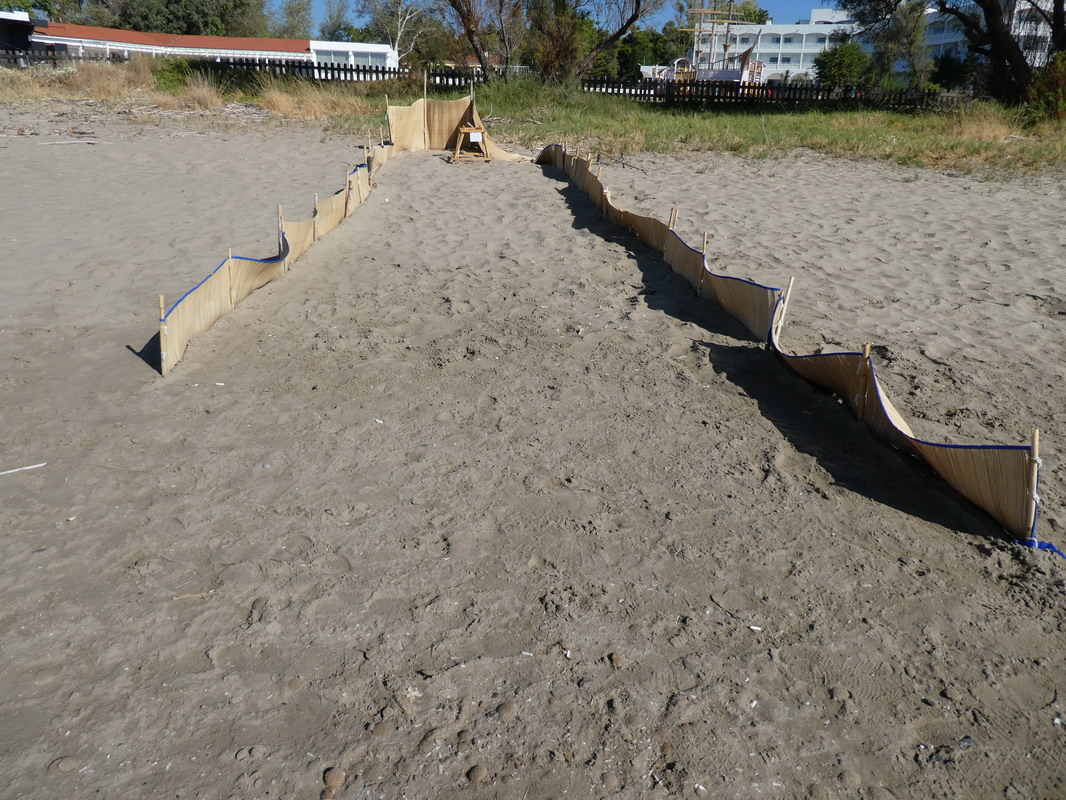


There were plenty of signs telling visitors to keep away, but I wondered how effective they would be in the nesting season. The first one in Romanian, Russian and Italian, the second one in Greek, English, Italian, Romanian and Russian -


The protection cage at each nest had a notice -

The hut for the rangers was of course deserted, being out of season, and had no information regarding the turtles that had visited this year. The only notice was this one -

There were no turtle tracks at all in the sand. However in the dunes behind the beach, I saw these tracks, would guess they are lizard but I don't know -


In egg laying season, the sheer numbers of tourists affect the turtles, especially at night when the lights and noise disturb them. And the newly hatched turtles have trouble finding the sea in all the confusion. And some uncaring hotel owners put down more sunloungers, thereby reducing the beach area available for nesting.

The turtles are not just harassed on land. Dozens of glass bottomed boats pursue them in the water, with tourists excitedly and noisely taking photos. This means a lot of turtles fail to reach the beaches. Even out of season in Sept, there were so many tour agencies selling boat tours to see the turtles swimming in the sea. And the shops are full of souvenirs relating to turtles, such as soft toys, swimming rings and lilos, and all kinds of ornaments etc.

When I was on the neighbouring island of Kefalonia, I went to the capital Argostoli, and was able to see the loggerhead turtles swimming in the harbour. This was so nice to see as the turtles were there without being hassled by anyone.


Video of the turtles -

See more on the Zante turtles on GreekIsland .


Monday, March 9, 2020

Iles du Salut, French Guiana

I was really sad to leave the Amazon and Brazil, as I had really enjoyed my time there. However I was also excited about the next stop, Isles du Salut in French Guiana.

French Guiana is an overseas department and region of the French Republic on the northern Atlantic coast of South America in the Guianas. It borders Brazil to the east and south and Suriname to the west.

The Guianas are a region in north-eastern South America which include three territories:

French Guiana, a region of France
Guyana, formerly known as British Guiana from 1831 until 1966, after the colonies of Berbice, Essequibo, and Demerara, taken from the Netherlands in 1814, were merged into a single colony
Suriname, formerly Dutch Guiana

France set up a penal colony on the mainland of French Guiana in 1848 and some 70,000 French convicts were sent here over 100 years. The labour camp stretched to the border with Dutch Guiana (Suriname). Malaria would have killed many convicts.

The most notorious penal colony was on the Iles du Salut.

Iles du Salut (Salvation Islands) are located approx 11 km off the coast of French Guiana, and approx 14 km north of Kourou. Though closer to Kourou, the islands are part of the French Cayenne Canton Nord-Ouest.

The name was given by the missionary White fathers and nuns who had fled to the islands from a yellow fever epidemic on the mainland. In 1604 there was a French settlement at the mouth of the Cayenne river and the missionaries were based there.

This small island group consists of 3 islands, named (from north to south) Ile du Diable (Devil's Island), Ile Royale and Ile Saint-Joseph.

Iles du Salut were once part of a penal colony for France's worst criminals, from 1852. As a penal colony, Iles du Salut had a reputation for extreme brutality and violence. Many prisoners died from tropical diseases. A small group of survivors were returned to France to share the terrible stories and scare potential criminals. The system was gradually phased out and was shut down in 1953.

On Ile Royale prisoners were allowed to roam around in moderate freedom because of the difficulty of escaping from the isle.
Ile Saint-Joseph was chosen for the worst criminals. They had hard labour and solitary confinement. Prison warders were buried here. Convicts who died or were executed were always thrown to the sharks.
Ile du Diable was used for political prisoners, although it started out as a leper colony.

At the end of their prison sentence, the prisoners had to stay on as free men for an equivalent number of years. However only 1 in 10 survived.
Drawing of the disposal of a corpse at the "Jette les mortes". Note the shark in the water!

Today, the Salvation Islands are a tourist destination. They were featured in Henri Charrière's novel Papillon. He was imprisoned here for 9 years.

Papillon had two years of solitary confinement on Île Saint-Joseph.  Papillon was transferred to Royal Island but after a failed escape attempt, he had to endure another 19 months of solitary confinement. His original sentence of eight years was reduced after Papillon risked his life to save a girl caught in shark-infested waters. He later faked insanity and was put in the hospital on Royal Island. He had another unsuccessful attempt at escaping.

He then asked to be transferred to Devil's Island, the smallest and most "inescapable" island. Papillon studied the waters and discovered possibilities at a rocky inlet surrounded by a high cliff. He noticed that every seventh wave was large enough to carry a floating object far enough out into the sea that it would drift toward the mainland. He experimented by throwing sacks of coconuts into the inlet. He made his escape this way, using sacks of coconuts for flotation. On the mainland he was helped to Georgetown, British Guiana and then on to Venezuela.  Read more on Wikipedia.

The islands are under the control of the Guiana Space Centre (Centre Spatial Guyanais). The CSG is a French and European spaceport to the northwest of Kourou in French Guiana. When rockets are launched in an easterly direction, the islands have to be evacuated. There are 2 policemen based on the island, they come from Paris and do 3 month stints on the island.


Royal Island is the main island tourists visit. Despite its horrific history, it is now a really pleasant and peaceful place. It is less than 1 km long. I started to walk round and was really excited to see the first capuchin, not realising how many more I would see. They are brown capuchins, also known as tufted. It was the same with the agouti, I saw one and later saw so many more.


Agoutis are rodents. This one looks like it has mange -


Director's quarters now used as the tourist office -

There are lovely big trees at the top of the hill


The chapel -

Old hospital and lighthouse


There were several capuchins around the children's cemetery. This child died aged 9 months.


I went past the Auberge which is now an expensive restaurant and bar and it also has accommodation. There are peacocks in the grounds. This agouti has facial wounds and the eye is slightly blue -

I had a look round the old cells. At least they had small windows at the top to let in some light. 


Quarters for the supervisors -

Looking across to Devil's Island from the Auberge. 

The coastline is rather pretty. This is the pool used by the convicts, now enjoyed by tourists. 


Devil's island again. There used to be a tyrolean to send the prisoners across.

This is St Josephs island -

I liked the island so much, I decided to do another round. Unfortunately part of the lower coastal path is closed for maintenance. I had time to watch the wildlife, especially as there were less human visitors. I watched one capuchin trying to get insects from a tree branch. Firstly it was banging the end of the branch on a rock, then it was pulling and biting the bark to get to the insects.


I had an apple with me, and gave small pieces to this capuchin


There are quite a few turtles around the island. I don't know the species as there are 4 in the area, Loggerhead, Green, Hawksbill and Leatherback. Of course, it is hard to get good photos as they only pop their head above water for a second or so.

Some more wildlife -


There is something really special about the island. By the end of the afternoon there was still a group of us who were all reluctant to leave. We left it till the last moment before bidding farewell to the island.

---

See the next blog on my Amazon & Caribbean cruise - Tobago.