These blogs are my non-cave photos and stories. The older ones are taken from my Multiply site, which closed in March 2013. I have a 2nd blog for the SE Asia cave items and a 3rd blog for non SE Asia caves.
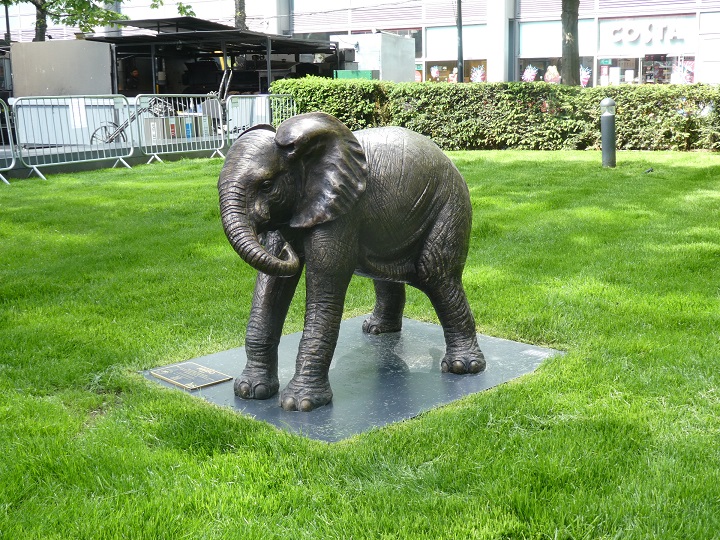
I recently saw the herd of elephants around the King's Road in Chelsea, London. I then went to see another herd that are situated at Spitalfields. Whereas the Chelsea elephants are made of an invasive plant, the Spitalfields are bronze. And they have a different significance. They represent real orphaned baby elephants that have beaten the odds to survive.
The elephants are located around Spitalfields Market. The market started in 1682 and lasted until the early 1990s. It is now a market with lots of individual arty/crafty type stalls, as well as many food and beverage outlets. Outside the market is used for outdoor artworks.
The Herd of Hope arrived in 2020.
The herd of 21 elephants were previously located at Marble Arch. They were there from Dec 2019. A mother elephant sat in the middle surrounded by 20 elephant calf sculptures. These were modeled from real orphaned baby elephants currently in the care of Sheldrick Wildlife Trust. This is a project in Kenya that protects elephants. Each sculpture includes the name of the orphaned calf they represent and their sad backstory.
Now the 21 elephants are scattered around Spitalfields market. I guess this separation is applicable considering the elephants are orphans, but it would be nice to see them in small groups.
This is the matriarch, she represents the mother and family each of the infant elephants lost when they became orphaned.
And some of the babies -
The elephant herd were created by Gillie and Marc. These artists have two other sculptures at the market. "Dogman and Rabbitgirl with coffee" (2017) represent unity and acceptance. "Gillie and Marc’s autobiographical characters, Rabbitwoman and Dogman, have a dream that open hearts and open minds can come together over a warm cup of coffee to promote diversity, love, and acceptance." -
Together Forever on Wheels, (2020). "Dogman and Rabbitwoman are back, but this time they’re on Vespas! The inspiration behind our latest addition was to try and encourage the public to step out of their front doors and fall in love with the world, people and animals in it." (Spitalfields public art)
Soon the Chelsea herd of elephants will be migrating to a new area, so I will have to go and find them in due course.
Went to Kelsey Park at Beckenham at the start of June and ended up taking lots of photos of birds. I particularly wanted to see the mandarin ducks, as a few days before I had been walking along my local river, the River Pool, when a pair of mandarins came out of the water and walked right up to me, presumably hoping for food. I had nothing for them and annoyingly I didn't have my camera with me. The next day there was no sign of them. Photo taken on phone -
In Kelsey the first one I saw was sitting by a tree. I took photos then got distracted feeding peanuts to squirrels. I soon found I had 5 mandarin ducks also after the peanuts, as well as a few pigeons.
I didn't notice any females. This appears to be a young male -
Mandarin ducks are native to the Far East but they are now widespread in the UK. See more on RSPB and Wildlife Trusts .
I then saw a cluster of Mallard ducks and thought they were fighting. But I soon spotted a female (hen) in the middle of scrum and realised the males were all attempting to mate with her. In the commotion, more males turned up. I Googled it later and found that gangs of young males are known to "gang rape" a female and this often leads to the female being seriously injured or even killed, or drowned if it happens in water. There is an interesting article about this happening regularly in Venice, posted in the Los Angeles Times.
I posted a video on youtube
The RSPB page says "Mallards start to pair up in October and November, and start to nest in March. The role of the male is almost over once the clutch is laid. He remains sexually potent for a while in case a replacement clutch is needed, but gradually loses interest and joins other males to moult. At this time groups of males with no obvious duties often mate forcibly with females that appear to be unattached. This anti-social phase is short-lived and ends once moulting is underway."
A mallard couple -
There were several families of geese with fluffy goslings. Both Canada and Egyptian geese are found here. These goslings camouflage well against the grass -
Some larger Egyptian youngsters -
A gaggle of geese. Seems they need some form of birth control! The Canada geese seem to be becoming a problem in the UK as there are so many of them. They are an introduced species and don't migrate so are resident all year. They are really common in parks and around lakes. The smaller Egyptian geese are also introduced but are generally just in SE England.
There are notices saying do not feed the geese, and do not feed any birds with white bread, but people ignore these and still give white bread as can be seen above.
I went to the park in the morning after a bank holiday weekend. Several rubbish bins had been emptied, presumably by foxes or crows.
The River Beck flows through Kelsey park, and then flows into the River Pool.
There are currently a herd of Indian elephants on the King's Road in Chelsea, London. So I went to have a look on 29 May 2021.
The project is known as CoExistence. Info from the Herd the news link : "Raising awareness for ‘CoExistence’, the new environmental art campaign from wildlife conservation charity Elephant Family, this extraordinary display of one of the world’s most precious mammals aims to raise funds for conservation projects that enable people and wildlife to live peacefully alongside each other.
From babies and adolescents all the way through to full-grown male tuskers, there is a beautiful story behind these intricate sculptures, made using Lantana camara, a natural plant material that was introduced to Asia where it became a notorious weed; toxic to grazing animals and outcompeting native species leading to a reduction in biodiversity. Over five years, a great amount of skill has gone into their creation, each sculpture inspired by a real, wild elephant that lives alongside their creators.
These masters of their craft are from indigenous communities in India who coexist with these elephants. With great understanding of the forest they share, they show these animals respect and know what to plant, where to walk and how to live within natures laws and rhythms. To find out more about the makers, visit their website here."
The 50 handcrafted life-size elephants are in Chelsea from 17 May to 6 June. A map of the Chelsea migration -
I started with the Royal Avenue herd, where there are 5 elephants -
The biggest herd is just up the King's Road, at Duke of York Square, aka Cadogan Estate.
I was walking past a fence and heard a noise and saw this squirrel. At first glance I thought it had a huge tumour on its face. I grabbed my phone camera and zoomed in, which was a mistake, as the phone camera doesn't do well on the zoom. I then realised the lump was actually a young squirrel.
It's the first time I've seen a squirrel carry its young. The young are kits or kittens and are born in March/April.
I saw the first fox cub on Easter Sunday, 4 April 2021. That's about 6 weeks earlier than normal.
Normally I first see the fox cubs in mid May, this has been consistent for the last 4 years. In 2020 it was the 12 May; 2019 17 May; 2018 on 17th May & in 2017 on 15 May.
In 2021 I was excited to see the first cub on April 4. I then saw 3 on the 7th. They were much smaller than when I normally first see them. They were also noticably darker. This is because their fur is very short and dark when born, normally in March, but by the time I see them in May, the coat has lightened in colour.
I later realised why I had seen them so early - they all seem to be living under the shed in front of my windows. In previous years they had been born in dens somewhere in the allotments and I only saw them when mum let them out after a few weeks. But this year I was particularly lucky in seeing them probably soon after their eyes had opened.
"Newborn fox cubs are blind, deaf, dark-grey in colour and weigh about 120g. After 14 days, their eyes open. Their pupils are slate-blue. Guard hairs appear, giving cubs a fuzzy appearance. They have small, floppy ears and weigh about 350g. After four weeks, the cub’s pupils are grey flecked with brown. The muzzle starts to lengthen. White fur appears around the mouth and patches of red on the face. The coat is still woolly, but the ears are now erect. After eight weeks, the pupils become amber-coloured and the cub’s face approaches adult proportions. Its fur is largely adult colour but still looks woolly."
Video of little wobbly legs on 17 April -
As the days progressed, I noticed there were some tiny cubs and some older ones, but they were all playing together. I don't know if the really small ones were just younger or if they are the runts! Quite often the bigger ones would just knock over the tiny ones, especially if rushing for food. They all seemed to be eating solids.
They were still suckling from mum. This mum has about 6 cubs all trying to feed with another 2 or so playing nearby, they are of different sizes so I don't know if they are all hers.
This vixen is suckling just 2 cubs -
Some of the smaller cubs lie on their backs to feed.
One of the younger cubs in the morning sunlight, it still has the fuzzy appearance -
and a possible sibling -
A bigger cub -
One of the parents -
Two parents and 3 cubs -
Cubs start eating solids at about 4 weeks. This one is eating a piece of pizza
This vixen is suckling 8 or 9 cubs, they don't keep still long enough to count. They seem to be of different ages so are probably not all hers -
I'll add photos as I get them.
***
June update :
By June the cubs were much more independent. However I did see a few of them trying to suckle from mum on 10 June, though mum wasn't so patient by then. The runts were still noticeably smaller than their siblings. One of the mums seemed to have a favourite who was often alongside her and would be allowed to take food or was given food.
Foxes are usually silent except during mating time. But one of the mums has become quite vocal. She calls a lot, I guess it is the equivalent of a dog barking or giving a yap to get attention. However the fox's call is quite high pitched and more like a cat. This mum has learnt to call when she wants food. She knows when humans are around, and sits and waits for food, giving a call now and again. And I watched one lady putting food down for the foxes, with the vixen sitting nearby calling, as if to say hurry up!
During May and early June, one or maybe two really annoying crows would caw loudly at the foxes. It would sit on the fence above the fox and just scream at it. The foxes would take no notice. Occasionally the crows would almost dive bomb the foxes. I don't know if it was because the crows had youngsters or a nest nearby - I don't know where the crows nest. The rest of the year this behaviour doesn't happen. Thankfully the crowd stopped this by mid June.
Magpies are also screeching at foxes this time of year, so I guess they have babies as well. The magpies often sit on the ground near a fox screaming at it, and sometimes even pecking the back end of the fox.
Another day there was an awful ruckus. It sounded as if every magpie in the neighbourhood was screeching, then lots of crows joined in (crows and magpies are normally "enemies") and there was also a fox "screaming". It sounded like a war. I got my binoculars and saw one fox sniffing at some black feathers. So I assume a fox managed to catch a magpie and ate it, then other foxes came to sniff the leftovers.
**
In July, the mums start competing with the cubs for food.
October is when the young foxes leave their families to go alone. And start growing their winter coat.