Enjoy!!!

Enjoy!!!

Sunday, October 16, 2022

The Flying Scotsman at King's Cross

 I don't have any particular interest in trains or the history of railways, but when I read that the Flying Scotsman steam train was at London's King's Cross station for a weekend, I went to have a look. 

The locomotive or steam train was in London for the weekend of 15-16 October 2022. This weekend marks the 170th anniversary of King’s Cross station. The station first opened its doors to rail passengers on 14th October 1852. It is also coming up to the 100th anniversary of the Flying Scotsman that was built in 1923. It was the first locomotive for the newly formed LNER (London and North Eastern Railway). Its name was given in 1924 when it was selected to appear at the British Empire Exhibition in London and named after the daily 10 am London to Edinburgh rail service.


The locomotive was in service until 1963. It was then privately owned until it was bought by the National Railway Museum in 2004 for £2.3 million after a major fundraising campaign to save it for the nation. I visited this museum in York in 1967, before the Flying Scotsman was owned by them. After about 10 years of renovation, the Flying Scotsman now does heritage train trips.

At King's Cross I was only able to see it from a distance, as you had to buy a ticket to get up close (in any case the tickets were all sold out). I could smell the steam as soon as I entered the station, and whilst I was there, there were occasional blasts from the engine letting off steam.


Nearby in the station there were stalls selling souvenirs of the Flying Scotsman. 

This weekend is just the start of the Centenary Programme which last until Nov 2023.


Crete - sunshine then flash floods

 I was on Crete on 4 Oct and enjoyed some nice weather. It was sunny and warm. So I was surprised to learn there were bad floods less than 2 weeks later. Storms hit the north coast on 15th, leaving at least two people dead. The worst place affected was Agia Pelagia, but the streets of Chania were also flooded. Agia Pelagia is just west of the capital Heraklion. Chania is to the west. 


Photo from Yahoo news -

Heavy rain caused flash floods which pushed cars into the sea.


Chania when I was there -

Chania mosque dominates the Venetian harbour. The main dome is supported by 4 arches and there are 6 small domes but no minaret. The name Turkish Mosque Yiali Tzami means seaside mosque. It was a place of worship until 1923, when the last Muslims left Crete at the exchange of populations between Greece and Turkey. It is now used for art exhibitions -

The Venetian harbour was built by the Venetians between 1320 and 1356. The harbour was used for commerce and also to control the Sea of Crete against pirates.The harbour had room for 40 galleys, but it constantly silted up and was never very deep, so it kept having to be dredged, a difficult job with the equipment of the time.

The lighthouse was built in 1864

The shipyards where the Venetians repaired their galleys


Part of the old town walls


I took a bus from Chania to Kolimvari, which is at the southeast end of a peninsula, about 25 km from Chania. 


Saturday, October 8, 2022

A quick look at Athens

 I had a view of Athens from the hop on hop off bus. There are 3 companies running these buses, I chose the red one as I had a coupon for 10% off the fare!

My first stop was at the Acropolis complex. The Acropolis, or Highest Point, is an ancient citadel that sits on a rocky outcrop above the city. It contains the remains of several ancient buildings, the most famous being the Parthenon. These buildings are of great architectural and historical significance. The rock is about 150 m high and is formed of schist over limestone. 


The Parthenon is a temple that was dedicated to the goddess Athena during the fifth century BC. It is currently undergoing renovation -

There were long queues to enter the site so I didn't bother to go in, as I wanted to see more of Athens. 
Entrance to the Temple of Zeus. Constructed was started in 174 BC. It had very tall columns but most of them have fallen down due to various earthquakes.

The Greek Parliament building, Syntagma -

This is a modern building, first used as a palace, from 1843. It was used for the Hellenic Parliament from 1929 and the building has been adapted over the years. The changing of the guards outside the palace is quite a tourist attraction. The soldiers come from a special unit of the Hellenic Army and guard the Monument of the Unknown Soldier in front of the Hellenic Parliament and the Presidential Mansion. Their unique uniform has a special meaning. They wear a Greek kilt, white tights and shoes with pompoms. Each hour they change guard. See more here.


The Panathenaic Stadium. It was built for the first modern Olympic Games in 1896 and remains the only stadium in the world built entirely out of marble. The word “stadium” comes from the ancient Greek measure of length, where one “stadion” was approximately 185 m and equivalent to the length of the track. See more on the stadium

The Academy of Athens is one of three buildings, along with the National Library and University. It is neoclassic, from 1859. It is made of marble. The two tall columns with Athena the defender on the left and Apollo the guitar player on the right -

Next door is the National library -

Omonia Square is one of the oldest squares in Athens and is in the shopping centre. It was built in 1846 but has been renovated over the years and the fountains redesigned -

Athens Central Market, or Varvakeios, is the biggest food market in Athens. It is situated between Monastiraki Square and Omonia Square on Athinas Street.


Monastiraki Square is a plaza surrounded by restaurants, bars and a Byzantine church (church not in this photo). The building with the brown dome is Tzistarakis Mosque. Built in 1759 it is one of the few Muslim monuments remaining in Athens. It is built with limestone -

Some other churches


The archaeological museum

And finally some street Christmas decorations in September -


Sunday, September 25, 2022

Museum of sex objects, London exhibition

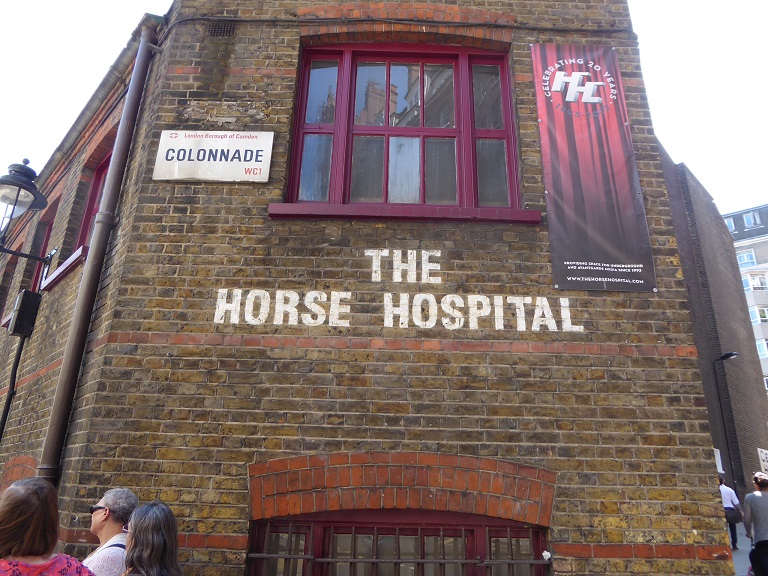
 A month long exhibition  featuring sex objects was held at the old Horse hospital in London. This is located at the Colonnade at Bloomsbury, just around the corner from Russel Square underground station.


The purpose of the Sept 2022 exhibition - "The Museum straddles the boundary between art, fiction, and history, tracing our sexual past via the many clues locked away in institutions or even hidden under beds. In more tolerant times, it is easy to forget that the struggle for sexual freedom came at such a cost to countless individuals. The Museum’s purpose is to scratch the surface, peel back some layers and bring history’s blind spots into the light." [taken from museumofsexobjects].

I was in time to join a mini tour by The Keeper, who was dressed in a long red cape. She gave us a short introduction to some of the objects on display. One whole wall is devoted to pictures, embroideries and drawings etc done for the exhibition


And the same on a replica of an old slate wall -


There are various displays on the struggle for sexual freedom and the road to feminism. 

"Experience clandestine meetings in A Space of Peril, exploring how dangerous public spaces were for gay men – from the 18th Century Molly Houses to Cottaging in the public toilets of the 20th Century." Molly-house was a term used in 18th- and 19th-century Britain for a meeting place for homosexual men. The meeting places were generally taverns, public houses, coffeehouses or even private rooms where men could either socialise or meet possible sexual partners. Men would often dress as women to go to the houses.

Sexual diseases were prevalent and there is a section on Dr Isaac Baker Brown, a notorious 19th-century English gynaecologist and obstetrical surgeon. He had a reputation as a specialist in the diseases of women and advocated certain surgical procedures, including clitoridectomies, as cures for epilepsy and hysteria. 


A Sheela na gig. These are figurative carvings of naked women displaying an exaggerated vulva. They are architectural grotesques found throughout most of Europe on cathedrals, castles, and other buildings. The greatest concentrations can be found in Ireland, Great Britain, France and Spain, sometimes together with male figures. See more on Wikipedia.


Throughout the centuries, small groups of artisans kept alive stories of sexual subversion alive, and often illiterate, marked their works with a red X. 

See more on the museum webpage. And more of the stories are shown on Ianvisits. 
--

The horse hospital is an 18th century building. It is located at the corner of Herbrand Street and Colonnade in a working mews. Built originally in 1797 by James Burton, it had stables for sick and tired horses belonging to cab drivers. It is now used as a progressive arts venue. See more on Wikipedia.

And some photos from 2016 -