Having visited other windmills in the Greater London area, at Shirley and also Wimbledon, I managed to book a tour of the Brixton windmill.
Brixton is in the borough of Lambeth in south London. The windmill is located in Windmill Gardens, a small park off Brixton Hill. The windmill was built in 1816 and is London's last working windmill. It is also open for tours a few times a year.
By booking, I was able to do the full tour, which goes up to the top floor. Unfortunately there is not a clear view of the windmill from outside, due to construction work of an education and visitor centre.
The sails are different, they are not the originals. The mill closed in 1934 and the new sails were made and added in 1964. It is a tower mill, as is the Shirley one. The structure is made of brick and wood and only the cap rotates. This means the tower can be taller and the sails therefore longer, so they can turn in lighter winds.
The mill was open to the public in 1968 but closed in 1990 and suffered vandalism and from lack of maintenance. It then received money from the Heritage Lottery Funding and is now open again. Tours are restricted to about 3 or 4 people.
The mill was owned by the Ashby family. The millstones were originally wind driven, but the sails were removed in 1864. In 1902 new millstones were installed, powered by steam. Today they are electric powered. We went straight up to the top floor, via sets of stairs. The original workers would have had to climb ladders.
Coming down a floor -
The electric powered millstones -
Examples of grinding stones. The middle one was imported from Zimbabwe, hand grinding. The one on the right shows how the millstones are curved, the weight crushes the grain which is fed in through the centre and pushes the ground flour out of the sides.
Thanks to Peter for a really informative tour.
Official site of Brixton windmill.
These blogs are my non-cave photos and stories. The older ones are taken from my Multiply site, which closed in March 2013. I have a 2nd blog for the SE Asia cave items and a 3rd blog for non SE Asia caves.
Enjoy!!!
Sunday, July 14, 2019
Wednesday, July 3, 2019
Tower Bridge, London, 125th anniversary
June 2019 saw the 150th anniversary of the London underground District line, and the 125th anniversary of Tower Bridge.
2016 photo of Tower Bridge -
For the 125th anniversary, Tower Bridge was open to the public for £1.25 (instead of £9.80) on 29/30 June. So I took advantage of this offer. There was a queue when I arrived, but it moved quite quickly.
When I paid I was given the option of using the lift but I chose to climb the 200+ steps up in the North Tower.
The first level has an informative display of informative. I then carried on up to the walkway level. There are two walkways, east and west. View of the City, taken through glass, hence the reflections -
Along the middle section there is a glass floor. Many people were sitting on the floor having their photos taken so it was difficult to find good spots for photos looking down -
Above is a mirrored ceiling
View looking southeast -
I then descended the South Tower to road level and follow the blue path with plaques to the Engine Room.
I then had to walk back across the bridge to get to the tube station
Looking up at the walkways with the glass floors -
2016 photo of Tower Bridge -
For the 125th anniversary, Tower Bridge was open to the public for £1.25 (instead of £9.80) on 29/30 June. So I took advantage of this offer. There was a queue when I arrived, but it moved quite quickly.
When I paid I was given the option of using the lift but I chose to climb the 200+ steps up in the North Tower.
The first level has an informative display of informative. I then carried on up to the walkway level. There are two walkways, east and west. View of the City, taken through glass, hence the reflections -
Along the middle section there is a glass floor. Many people were sitting on the floor having their photos taken so it was difficult to find good spots for photos looking down -
Above is a mirrored ceiling
View looking southeast -
I then descended the South Tower to road level and follow the blue path with plaques to the Engine Room.
I then had to walk back across the bridge to get to the tube station
Monday, June 24, 2019
A stream train on the London underground
I'm not a train or railway enthusiast, but when I read that a steam train would be running on the London underground, I had to go and have a look.
To mark the 150th anniversary of the District line, a steam train ran along parts of the London Underground. This was the last time steam trains are expected to travel into central London on the Underground network, due to signalling modernisation that will provide more frequent services and improved reliability on the Circle, District, Hammersmith & City and Metropolitan lines.
Steam trains served the District Railway when it first opened to the public between South Kensington and Westminster on Christmas Eve, 1868.
There were 3 journeys each day on June 22 and 23. The route was from Ealing Broadway to High Street Kensington and back. On the outward journey the train ran "backwards" towards High Street Kensington, pulled by the 1923 Sarah Siddons electric locomotive. For the return journey, the steam loco Metropolitan 1 pulled it back to Ealing Broadway.
The train was comprised of the following locomotives and carriages:
Metropolitan No.1 steam locomotive
Bluebell Chesham Coaches, 387, 412, 368 & 394
District Railway Coach No.100 from the Kent and East Sussex Railway
London Transport Museum’s Metropolitan Jubilee Coach 353
Sarah Siddons electric locomotive
Tickets to ride the train were sold out in advance, despite costing over £150.
I went to Earls Court station for my first viewing. I was standing right on the platform as the train came in, which was too close for good photos
I then jumped on the regular underground train and went to Ealing Broadway, where the steam train was being watered, in preparation for the 2nd journey. People were dressed in Victorian costume and there was heritage Victorian brass instruments playing. Only ticket holders could go onto the platform where the train was standing.
And a view looking down
Sunday, June 23, 2019
Madeira north and west coast
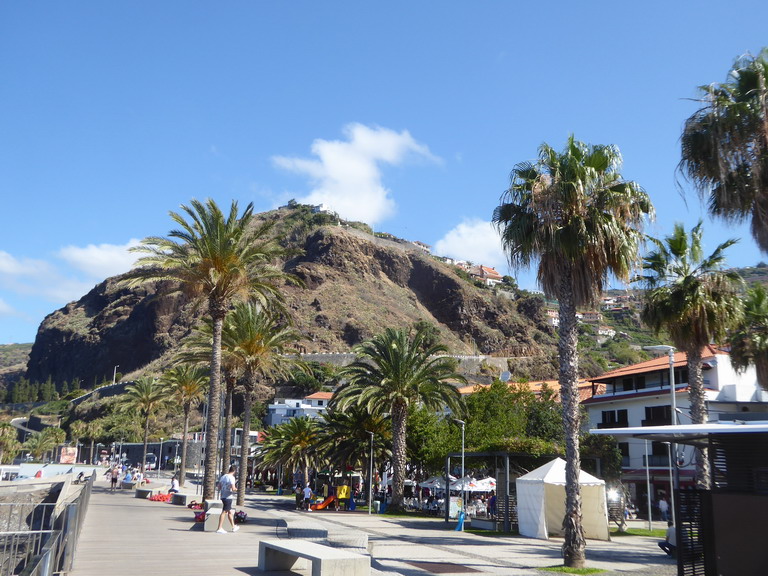
Having seen the northeast side of Madeira, my next tour was to the northwest. The first stop was at Camara de Lobos which I had been to the day before. We then went up to Cabo Girao which is Europe's highest cliff and said to be the second highest sea cliff in the world, at 580 m above sea level. There is a glass skywalk. And of course a lot of visitors.
We continued on, past a fish farm in the sea, and our next stop was at Ribeira Brava. It was Sunday and there was a Mass at St Benedict church. During this there were several very loud cannon blasts from the hilltop fort opposite, and some more at the end when the procession came out of the church.
The sea front and hilltop fort-
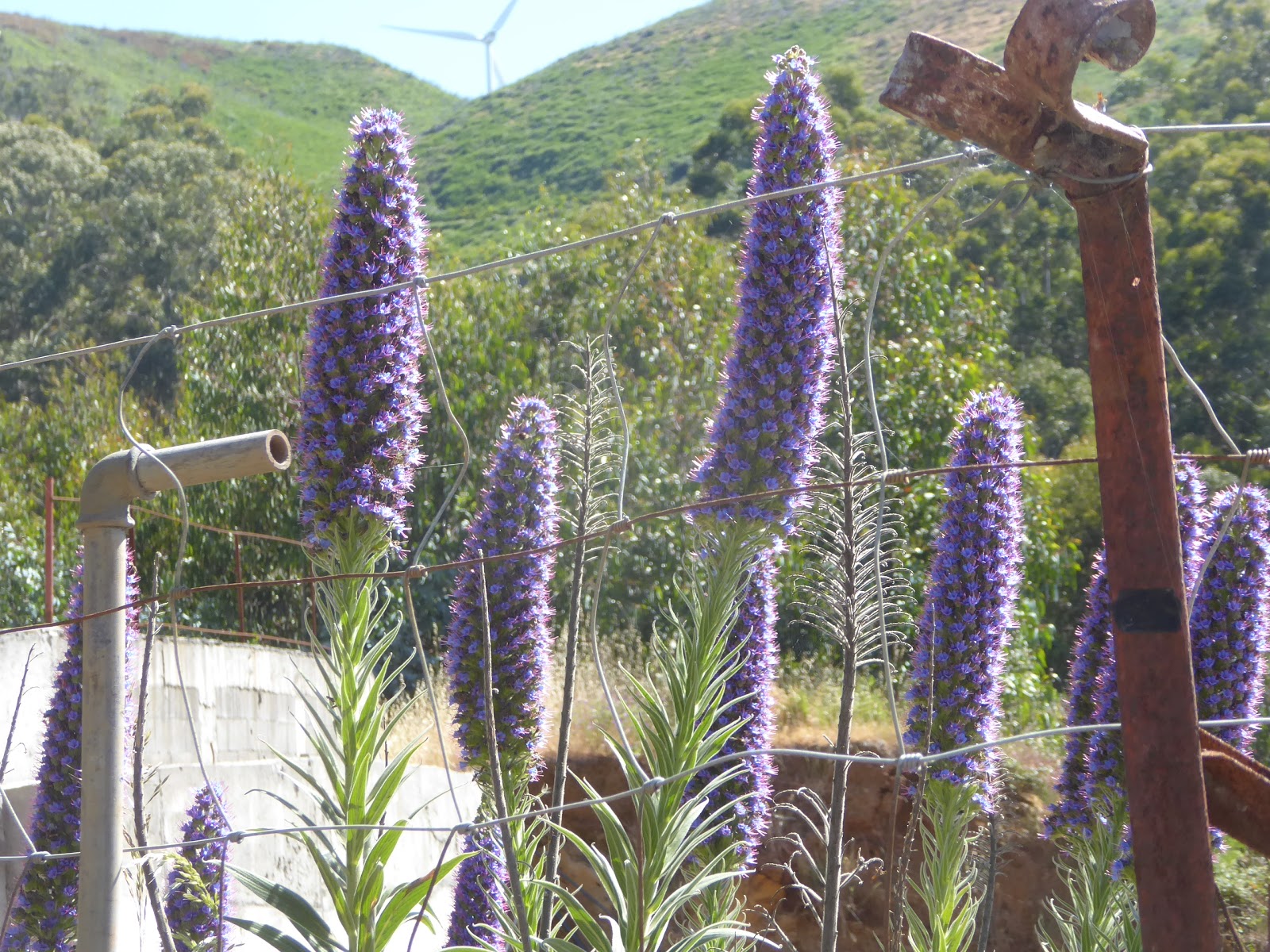
On past Ponta do Sol. We then headed inland, through Carnas, and uphill to Paul da Serra, the plateau. It was a nice winding road, through eucalyptus forests and we saw the native plant, Pride of Madeira -
We entered the national park, Malhadinha, where cattle are grazed. Paul da Serra at 1,300 - 1,500 metres above sea level is the flattest place in Madeira. There are wind turbines and solar panels. There was lots of yellow broom everywhere
To the north of the plateau is the laurel forest, or laurisilva. This is a UNESCO World Heritage Site as it is the relict of a widespread earlier forest. As we began the descent to the north coast we saw lots of bay trees. Stopped at a viewpoint of Relva do Jordao and could hear the river somewhere in the valley. There are lots of springs in this area.
Further down there were lots of white hydrangea alongside the road. We stopped at the Eira da Achada viewpoint
Next stop was Porto Moniz. This is famous for the salt water swimming pools formed by volcanic lava
The town and mountains behind
We then drove along the coast, through the small town of Seixal and stopped at Veu da Noiva viewpoint with a waterfall
A bee in the Agapanthus -
Next was Sao Vicente. The graveyard was full of flowers -
Young Jacaranda -
This is not a church. It is a clock tower and there are 4 clocks each showing different times - they were used to control the water allowed into the fields from the levadas
We took the old road back through the mountains to Funchal, stopping at Encumeada view point. There was a festival going on. You can see both the north and south coats, this is the view south -
Then it was back to Funchal.
Subscribe to:
Posts (Atom)